The Blog of Jack Holloway
Showing posts with label donald trump. Show all posts

Friday, June 23, 2017

Let's just say it, Republican Christianity is Idolatrous Heresy


I am done pretending that Republican Christians are biblicists.

They often parade themselves as those who "judge any candidate's beliefs against the absolute authority of God’s Word."[1] But this is, to use Paul's word, skybala--rubbish, bullshit.

81% of white Evangelicals voted for Donald Trump.[2] They didn't do this because they judged which of the two candidates were the more biblical. They may say this is the reason, but it's just not true. It couldn't possibly be true, because everywhere the Bible talks about an ideal leader, it describes someone entirely unlike Trump.

So how did they decide?
Before I get started, I want to clarify that I am not referring to Christians who are also Republican, but the hyphenated Christian-Republicanism, Republican-Christianity, the ideology that ties Republican values with Christian values, that fails to distinguish the two, and so claims a theological sanction for Republican politics.
Growing up in the world of Republican Christianity, I was taught the things they emphasize in elections, and this election turned out to not be any different.

Wayne Grudem captured just about all the angles in his three posts about voting for Trump. Referring to the prophet Jeremiah's teaching to "seek the welfare of the city" where God has sent you, Grudem said Christians have "to vote in such a way that will 'seek the welfare' of the United States." The question is then, "Which vote is most likely to bring the best results for the nation?"[3]

Jerry Falwell, Jr. similarly stated, "Jesus said render unto Caesar the things that are Caesar's. And that means be good citizens and choose who would be the best leader for the country."[4]

Their appeals to particular Bible verses might make it seem like they are trying to be biblical in their political thought, but beware lest you be led astray. Their assessment of the "Which vote" question is far from biblical.

Grudem asks, "Can I in good conscience act in a way that helps a liberal like Hillary Clinton win the presidency?" Or, he asks, should he taken the "unusual opportunity to defeat Hillary Clinton and the pro-abortion, pro-gender-confusion, anti-religious liberty, tax-and-spend, big government liberalism that she champions"?

The message is clear: liberalism is entirely contrary to Christianity. Liberalism is the enemy. The Christian thing to do is to "defeat" liberalism. Again, he quotes Scripture: "'Whoever knows the right thing to do and fails to do it, for him it is sin' (James 4:17)."[5]

Grudem then goes on to specifically address various key issues. The best candidate would appoint Christian-minded supreme court justices, oppose abortion, fight for religious (i.e. Christian) liberty, defend Christian business owners and Christian schools, and fight to represent Christian churches.[6]

This essentially captures the thinking behind support for Trump. The thread that runs throughout can be stated quite simply: political power for Christians. As Pastor Mark Burns stated, Trump "is going to make sure we as Christians are protected when he gets to the White House!" Similarly, he said Trump is "fighting for Christianity." Trump, he claims, “believes [Christian values] are one of the core values that has made America great and we need to get back to those values."[7]

Eric Metaxas echoes these sentiments. Liberals, he says, are going to make it illegal to say homosexuality is a sin, so we need someone like Trump to defend our religious liberty.[8]

Others, however, add others reasons as well. Falwell said that in Trump, "Evangelicals have found their dream president." In his justification for this, he said Trump appointed people of faith to his cabinet, fights to defend Christians in the Middle East who are being killed by radical terrorists, and also points to Trump's emphasis on securing U.S. borders.[9]

Metaxas also emphasizes borders.[10] This is due to his theological reading of the American nation. He says, "My earnest hope is that most Americans will learn again to love their country, and will understand that not to do so is like refusing to love oneself or one’s children." He says Americans are, "to use Lincoln’s phrase, God’s 'almost chosen people.'" America is "a beacon of hope and freedom to the world."[11] On this basis, he defends Trump's "America First" policy.[12]

Put it all together, and you essentially have three major points for Republican Christian political thought: 1) Liberalism is the enemy; 2) Christians need political power; and 3) America is theologically significant and so must be defended as such.

Nothing about any of these sentiments is biblical in the Christian sense. The first, that liberalism is the enemy, comes not from the Bible but from Republican politics. Grudem doesn't get his aversion to "tax-and-spend, big government liberalism" from biblical values. He gets it from Republican values. All kinds of attempts are made to defend it on biblical terms, of course, but, if we're honest, the reason why Grudem thinks this way has nothing to do with the Bible, but with Republican influence, with a tendency toward conservative politics the foundation of which certainly does not lie in Scripture.

The second concern, that of Christian political power, also has nothing to do with the Bible. Christianity has never had anything to do with demanding rights, with political power, or with ruling the secular world.

Paul says, "Do nothing out of selfish ambition" (Phil. 2:3). The Greek word for 'selfish ambition' denotes one who demands his own rights, who "seeks to promote his own cause."[13] Instead, Paul says, "Let your benevolence be evident to all!' (4:5). The Greek word for 'benevolence' denotes a quality "that keeps one from insisting on his full rights … or from making a rigorous and obstinate stand for what is justly due him."[14]

The earliest Christians suffered injustice, they suffered persecution. Jesus said, “Blessed are those who are persecuted for the sake of righteousness, for theirs is the kingdom of Heaven.” He said, "Blessed are you when people persecute you and insult you and falsely say all kinds of evil against you on account of me." He said, "Rejoice and be glad! Your reward in Heaven" (Matt. 5:10–12).

Kierkegaard even went so far as to say, "let persecution come--that very instant Christianity again exists."[15]

When their rights were threatened, early Christians didn’t make it their goal to gain as much political power as possible in order to ensure their safety and comfort. Karl Barth was quite apt when he said, "Whenever the Church has entered the political arena to fight for its claim to be given public recognition," it has always been "an impenitent, spiritually unfree Church."[16]

Republican Christians, on the other hand, have become like the world in their pursuit of political power. They then completely neglect the rights and needs of others. But this is entirely opposed to the heart of Christian faith. Christians concern themselves with the needs of others or they aren't Christians.

If Grudem really wanted to get his political thought from Jeremiah, he would have payed attention to 22:16, where it says defending the cause of the poor and needy is what it means to know the Lord. How is it possible that defending the cause of the poor and needy has never been a part of the "biblically-minded" Republican-Christian platform?

The third concern of Republican Christianity, the identification of God with the American nation, is also entirely unbiblical. The Bible only recognizes one God, the God of Jesus Christ. This God is not revealed in this or that human group, or this or that human power, but alone in the revelation of Jesus Christ.

In his day Karl Barth blasted an idolatrous theology that put the German nation on par with God's revelation in Jesus Christ. One of his contemporaries, Emmanuel Hirsch, stated that allegiance to the German people and the German state could only be denied by disobedience to God. In this spirit, he supported National Socialism. He said of Hitler, "Not one people in the world ... has a statesman who takes Christianity so seriously. When Adolf Hitler ended his great speech on 1 May with a prayer, the whole world felt the wonderful sincerity of it."[17]

Compare these remarks to those of Falwell and Burns!

My point is not to equate Trump to Hitler, but to point out the danger of idolizing a nation and a leader the way Republican Christians have done. Against such idolatry, Barth insisted on the revelation of Jesus Christ in the Bible as the sole source of faith.

Republican Christians may pretend to be biblicists, but they do not believe in the Word of God as the sole source of revelation and faith. In practice, they place Republican values on par with Scripture, Republican enemies on par with the enemy of God, and the American nation on par with the kingdom of God.

In his third article on voting for Trump, Grudem considered the question, "Are there no limits to what you will tolerate in a candidate?" He remarked that this question troubled him, but ultimately he disregarded it, coming to the conclusion: "because I agree with his policies, Trump is the far better choice."[18]

And so he reveals his answer. As long as a candidate opposes liberalism, promises Christians political power, and protects America's all-so-sacred borders, he will vote for anyone, forgive anything, overlooking any sin and injustice. He would vote for the devil himself if the devil was so disguised.

I speak, not as a liberal in defense of liberalism, not as a lefty against right-wingers, not as a radical against the enemy, but as a Christian, as a student of the Bible, as one who seeks after Jesus Christ, as a witness to the Word of God. I do not act as if my political views comprise the biblical or the godly alternative, but I can certainly recognize idolatry when I see it.

Grudem, Falwell, Metaxas, Burns, and all others like them, reveal themselves to be the truest heretics. They have committed themselves to an idolatrous heresy, and have completely compromised both Bible and Gospel. They have abandoned the first commandment, "Thou shalt have no other gods before me."

They have no business associating themselves with the Word of God. They would do better to stay home and stay quiet than spoil the integrity of the Word of God by representing it so miserably.

"They have been quick to turn away from what I commanded them and have made themselves an idol cast in the shape of a calf. They have bowed down to it and sacrificed to it and have said, 'These are your gods, Israel, who brought you up out of Egypt.'" Exodus 32:8


References:
[1] https://answersingenesis.org/ministry-news/ministry/donald-trump-phenomenon/
[2] http://www.pewresearch.org/fact-tank/2016/11/09/how-the-faithful-voted-a-preliminary-2016-analysis/
[3] https://townhall.com/columnists/waynegrudem/2016/07/28/why-voting-for-donald-trump-is-a-morally-good-choice-n2199564
[4] http://abcnews.go.com/Politics/meet-pastors-support-donald-trump/story?id=38406350
[5] https://townhall.com/columnists/waynegrudem/2016/07/28/why-voting-for-donald-trump-is-a-morally-good-choice-n2199564
[6] Ibid.
[7] http://abcnews.go.com/Politics/meet-pastors-support-donald-trump/story?id=38406350
[8] http://ericmetaxas.com/media/articles/eric-metaxas-bonhoeffer-brexit-backing-trump/
[9] http://www.huffingtonpost.com/entry/jerry-falwell-jr-dream-president-trump_us_5906950fe4b05c3976807a08
[10] https://townhall.com/columnists/waynegrudem/2016/07/28/why-voting-for-donald-trump-is-a-morally-good-choice-n2199564
[11] http://ericmetaxas.com/media/articles/wall-street-journal-promise-president-trump-eric-metaxas/
[12] http://ericmetaxas.com/media/articles/atlantic-evangelical-christian-defends-trumps-first-week-office/
[13] Karl Barth, Epistle to the Philippians, trans. James W. Leitch (Louisville: Westminster John Knox Press, 2002), 55.
[14] Gerald F. Hawthorne, Philippians, Vol. 43 of Word Biblical Commentary, eds. David A. Hubbard and Glenn W. Barker (Waco: Word Books, 1983), 182.
[15] Kierkegaard, Attack upon 'Christendom', trans. Walter Lowrie (Princeton: Princeton University Press, 1968), 177.
[16] Karl Barth, "The Christian Community and the Civil Community," in Community, State, and Church: Three Essays (Eugene: Wipf & Stock Publishers, 2004), 166.
[17] Quoted in Timothy, J. Gorringe, Karl Barth Against Hegemony: Christian Theology in Context (New York: Oxford University Press, 1999), 130.
[18] https://townhall.com/columnists/waynegrudem/2016/10/19/if-you-dont-like-either-candidate-then-vote-for-trumps-policies-n2234187

Thursday, May 11, 2017

A Little Bit of Marxist Theory: Lenin on How to Inspire a Revolution

In “What is to be done?” Lenin argues against the idea that revolution just happens, that resistance manifests itself spontaneously among the working class. Lenin saw this view espoused in the paper Rabochaya Mysl. An article in this paper claims that “The virility of the labor movement is due to the fact that the workers themselves are at last taking their fate into their own hands, and out of the hands of the leaders” (quoted on p.78). Lenin explains that those who espouse such views “imagine that the pure and simple labor movement can work out an independent ideology for itself, if only the workers ‘take their fate out of the hands of the leaders’” (p.81).

Lenin calls this “a profound mistake,” because it neglects the all-too-important aspect of ideology, the way that the masses are manipulated into embracing the status quo. “Consciousness was completely overwhelmed by spontaneity,” he claims (p.79).

Not only do the theorists Lenin criticizes neglect ideology, but they actually put down theorists like Lenin for “exaggerating the role of the importance of ideology” (p.81). They assume the revolutionary consciousness will organically develop amid the working class. As Karl Kautsky explained, they “believe that Marx asserted that economic development and the class struggle create not only the conditions for socialist production, but also, and directly, the consciousness of its necessity” (quoted on p.81). What is neglected, then, is the way ideology reinforces the status quo, and promotes complacency among the working class. Furthermore, the necessity of a counter-claim, of a subversive ideology, is neglected as well.

Lenin’s concerns, then, should easily be appreciated. We cannot downplay ideology in a resigned, “It will work itself out” mindset regarding revolution. We are up against a vast apparatus designed to pacify the masses. We cannot assume that revolutionary consciousness will just happen. (After all, in our own time the struggles of a good portion of the working class have led not to revolutionary consciousness but to Donald Trump!) What is needed is a Social-Democratic consciousness, and this does not organically arise from the workers, according to Lenin.

The workers are limited to “trade union consciousness,” which only leads to “fighting against the employers and for striving to compel the government to pass necessary labor legislation, etc.” (p.74). Trade union consciousness is that which is still compatible with the status quo. The theory of socialism, however, is a different matter—and it “grew out of the philosophic, historical and economic theories that were elaborated by the educated representatives of the propertied classes, the intellectuals” (p.74). Kautsky similarly states that “Modern social consciousness can arise only on the basis of profound scientific knowledge” (quoted on p.82).

So, according to Lenin and Kautsky, Social-Democratic consciousness was arrived at by intellectuals who followed the right path through reason, and they in turn introduce it to the proletariat, who can then be equipped to apply it. Thus, as both Lenin and Kautsky state, “socialist consciousness is something introduced into the proletarian class struggle from without (von Aussen Hineingetragenes), and not something that arose within it spontaneously” (quoted on p.82). Resistance is inspired by the philosophical and theoretical wisdom provided by those like Lenin and Kautsky.

This, however, is where Lenin, in my mind, takes a wrong turn. His is a highly romantic rendering of intellectuals, no doubt stemming from Enlightenment ideals similar to those of Immanuel Kant. In “What is Enlightenment?” Kant states that the masses are too fond of their tutelage to enlighten themselves, so that each has become “really incapable of making use of his reason, for no one has ever let him try it out.” Thus, “the public can only slowly attain enlightenment.” They need help from free intellectuals like Kant in order to be free. The Enlightenment intellectuals are like the philosophers from Plato’s cave analogy, leading the deceived cave dwellers (who cannot lead themselves) to the light of day.

This is the ideological tendency Lenin displays in his essay. On the one hand, he has a consciousness which is sensitive to the interests and needs of the working class (after all, he is a communist); but on the other hand, he displays an elitist and privileged understanding of the theory of resistance. While we cannot depend on the working class organically developing its own revolutionary consciousness, we can no more depend on the reasoning of intellectuals being charitable and just.

Lenin demonstrated with his appointment of Stalin as General Secretary that intellectuals cannot be depended on for doing what is best for the masses. Lenin's philosophy too easily made way for the authoritarian regime of Stalin. And so the idol of the Intellectual Messiah totters.


Page numbers from: V. I. Lenin, “What is to be done?” in Essential Works of Lenin, ed. Henry M. Christman (New York: Bantam Books, 1966).

Wednesday, February 8, 2017

Donald Trump is Not a New Yorker


At the Women's March last month, the best protest sign I saw all day said,
"CITY TO TRUMP: DROP DEAD."

A little NYC history is needed in order to understand this sign.

In 1975, the city of New York confronted a significant financial crisis. It was close to filing bankruptcy as it did not have enough money to cover normal operating expenses and had been denied the necessary loans. The only thing that could save the city was a loan from the federal government.

Initially, president Gerald Ford denied the loan, saying, “I am prepared to veto any bill that has as its purpose a federal bailout of New York City to prevent a default."

NY Daily News then published a front page story with one of the most famous headlines of NY history: "FORD TO CITY: DROP DEAD."

The message was clear: by denying the city any aid, Ford was issuing its death warrant. Two weeks later, Ford signed a bill that allocated $1.3 billion to help the city recover, after being advised that letting the city default would bring the worse outcome.

The "CITY TO TRUMP" protest sign that I saw at the Women's March was my favorite because it said so many things at once. It was a reference to a famous headline in NY history, the article of which concerned the very survival of the city. By alluding to this historic event, the protest sign made the bold statement that Trump's views and policies are fundamentally anti-New York.

Donald Trump is not a New Yorker, this sign proclaims. And it's correct.

I have found several articles from different New York newspapers and magazines addressing the question: What makes a true New Yorker? Each article provided a collection of quotes from different New Yorkers, and the comments sections offered even more. They ranged from, "You had to be born here," to, "If you live here, you're a New Yorker."

I was not born here. I have only lived in New York for a year and a half. But I am tempted to say that I am more of a New Yorker than Donald Trump, and that's because I have learned enough about New York and its history to know that Trump's policies go against one of the essential parts of what has made New York New York from the first couple decades after the Dutch settled in what they called New Amsterdam.

The word 'xenophobic' has been thrown around a lot since Trump has come to the fore of American political discourse. It's one of those big bad words that gets thrown in with "racist, sexist, homophobic, et al." I never used it, but, honestly, it's because I didn't know what it meant (and I have the suspicion that many others who do actually use it don't know what it means, but simply adopt it as part of their kneejerk liberalism). Now that I know what it means, however, it certainly describes Trump's outlook.

Xenophobia, simply put, is fear of the other. It manifests itself in prejudice against strangers and foreigners--refugees, immigrants, Muslims, etc. Trump's entire outlook on foreign affairs could be identified as xenophobic. His travel ban is fundamentally and categorically xenophobic.

New York City, on the other, is the anti-xenophobia city par excellence. Only a couple decades after the Dutch settled here, 18 languages were spoken in the small area of New York that we now know as lower Manhattan. I need not describe the present diversity in New York City, as I would only be reiterating what everyone already knows about New York.

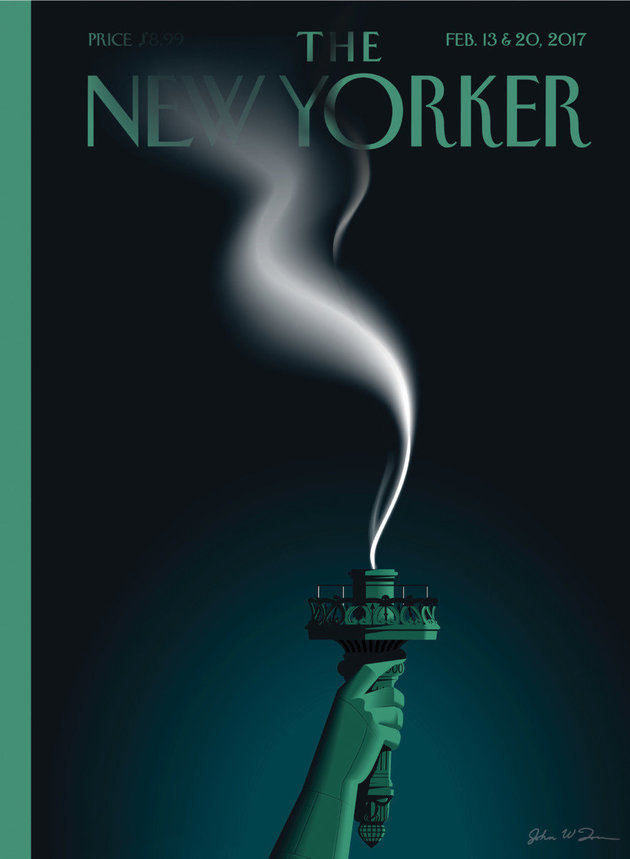
The Statue of Liberty's presence at the entryway of the city's port is the most appropriate statement of what New York is and represents.

"Give me your tired, your poor,
Your huddled masses yearning to breathe free,
The wretched refuse of your teeming shore.
Send these, the homeless, tempest-tost to me,
I lift my lamp beside the golden door!"

This, the city proclaims to the world, and the call has never gone unheeded. People have come from all over the world to participate in the democratic dream that is New York City.

The dream of New York is the dream Donald Trump wants to crush with xenophobia and nationalism.

And that is why Donald Trump is not a New Yorker.

And that is why the city declares to Trump:

Drop dead.

Thursday, October 27, 2016

My Email to Regent University's Executive Leadership


Good morning,

I am an alumni of the Regent University College of Arts & Sciences. I am emailing Regent's executive leadership concerning the Trump rally that was held at the university last Saturday.

I am extremely disappointed in the University for failing to raise a voice of dissent against such a man as Donald Trump. In the news article accompanying the rally, the event is said to have been from a "desire to expose Regent students to a variety of thought-leaders within the political process." I understand the logic but ultimately think it falls apart.

First of all, a campaign rally 2 weeks before an election is not an exercise in exposing students to political thought and leadership. You gave Donald Trump a platform on which he could rally for support in the home stretch of his presidential run.

Secondly, you gave Donald Trump a platform. Donald Trump, who is play-acting as Christian in order to manipulate evangelicals to vote for him. Donald Trump, who has been accused of sexual assault by over a dozen women. Donald Trump, who has continually been vulgar and childish, and has again and again advocated dangerous ideas, like the use of war crimes and extreme discrimination.

Regent inspires to raise up “Christian leaders to change the world." You do not change the world for the better by supporting a tyrannical, self-interested fraud. You do not change the world for the better by supporting a sexual predator. You do not change the world for the better by supporting a man who spits at what is godly and despises what is Christ-like.

Humility. Service. Compassion. Love. Self-sacrifice. These are the characteristics of Christ. Trump has clearly demonstrated that he doesn’t care about them at all. How can you possibly give a platform to such a man?

Even worse, you let vendors sell horrifying merchandise on the Regent campus--shirts that say "Trump that b*itch!", shirts that depict Trump urinating on Hillary's name, posters of targets over Hillary's face that say "Killary Rotten Clinton." That you can be a Christian university and give opportunity to this kind of hate culture is absolutely astonishing to me.

I am incredibly disappointed in my alma mater. The world is watching, and instead of raising up a prophetic Christian voice, you gave a demagogue a platform. I can only hope that there were students and faculty and staff who protested. If there weren't, then I can be sure that there was no Christian voice heard at Regent on Saturday, October 22, 2016.


Tuesday, August 16, 2016

Ariel Pink is a Heretic

As Secretary-treasurer of the International Society for Heresy Studies, I attended the ISHS conference in June. After the conference, we were asked to write a reflection on what we encountered at the conference. My reflection ended up being a profile of Ariel Pink as a heretic. The piece is featured in the ISHS newsletter, but I figured I would post it here. 

At the 2016 Heresy Studies conference I was particularly struck by Jeff Robbins’ discussion of what it might mean to be a heretic today. He first looked at the example of Spinoza, who was condemned as a heretic. What qualities did this event have that can be found today? Robbins emphasized two: loneliness and sacrifice. A heretic is one who espouses something that alienates her and costs her. A heretic is an outcast, one who occupies a negative space, rejected on more than one front. A heretic is also someone who suffers for what she espouses. Robbins offered Pier Paolo Pasolini as a potential heretic today. I suggest Ariel Pink to be another.

Ariel Pink is an experimental pop musician. In addition to being a musical genius, he is known as “the most hated man of indie rock.” This is because of the way he has presented himself to the world. His philosophy is to “get in touch with your weird.” In Ariel Pink’s life, this has often manifested itself in outlandish and offensive statements in interviews, on stage, and on social media. Pink, says a writer for The Guardian, not only deviates from the artist’s script of kneejerk liberalism, but rips it up entirely, which has led him into strange territory. “It’s not illegal to be an asshole,” he says, in response to a question concerning misogynistic comments he made when he recalled being maced by a feminist. He had initially responded to the accusation by tweeting, “What if I committed suicide and tweeted, ‘Thank you, guys. You were right’?” Pink has also playfully criticized homosexuals for wanting to get married, and has flippantly dismissed activist groups.

It is difficult when encountering certain statements from Pink not to think of Donald Trump (a comparison Pink might actually invite!). However, Pink seems less invested in what he’s saying, and he says it with an understanding that he does not have a substantial group of defenders. His fans may like the music, but that does not stop them from despising (or at least objecting to) the person. His purpose (if he can be said to have one) is, for better or for worse, to be subversive to a P.C. culture that claims the moral high ground and polices speech. What I thought about when I was listening to Robbins’ lecture was that the most hated man in the indie rock world—a world characterized by hypersensitive reactionism—takes up a heretical position. It has, as Robbins says of the heretic, cost Pink a lot, taking a toll on his life and career. Pink, like Pasolini, stands alone, and without defense.

That heretics are cool seemed to be a common sentiment at the Heresy Studies conference (and, generally, you wouldn’t look to me to contradict it). Pink, however, gives us an example of a heretic who may actually not be cool. While the subversive role is a much-needed one, heretics give us no guarantee that we’re going to like the way they play it.

Thursday, June 23, 2016

Abortion and the Supreme Court: Why Christians Shouldn't Vote for Trump Out of Fear


Now that Donald Trump has his Evangelical Advisory Board, he is going to do everything he can to win the Christian vote. The strategy has already been made clear: Trump will vow to put an anti-abortion judge on the Supreme Court.

The message is clear: A vote for Trump is a vote against abortion. Don't vote Trump and you risk voting for abortion.

Of course this logic is going to appeal to Christians. But it shouldn't. A law prohibiting abortion is not going to have the desired effect Christians that want, because the root problem of abortion is not that it is legal.

Let me illustrate my point with an example from the Bible.

In ancient Israel, King Josiah initiated a comprehensive reform of Israelite practices after a long period of idolatry and false worship. Around this time, so the story goes, the temple law book was found. The finding of the law book gave direction to the King's reform. The goal of the reform was a re-orientation of Israelite life to be centered on God.

The prophet Jeremiah began his prophetic career during the same period. Scholars have debated what Jeremiah thought about the reform, because he does not mention it, and rarely mentions Josiah. Whatever he thought of it, it is clear that it was not enough for him.

It was not enough because Jeremiah did not formulate his opinion concerning the spiritual state of Israel merely on whether or not an official reform initiated by the king was taking place. Jeremiah would only be satisfied by a turning of the entire heart toward God, a reformation of the heart of the people of Israel.

"Circumcise yourselves to the Lord," he says, "remove the foreskin of your hearts, O people of Judah and inhabitants of Jerusalem" (4:4).

The people of Israel needed much more than a legislative reform. They had sin written on their hearts (Jer. 17:1). No law could change that. The reform they needed could only be initiated by God. They needed God to create in them new hearts with the law of God written inside (31:33).

Likewise, the people in our nation need a thorough reform of the heart. They need God to change them from the inside out. They need the gospel. They need the love of Christ. This is what we should be seeking. We need to change this nation with the love of God from the inside out, not from the outside in with laws establishing our Christian values.

It is easy to see a problem and think, "We need an immediate, top-down solution to this!" The more difficult work is asking, "What were the conditions which brought us this situation?" What are the conditions that brought about abortion? What are the conditions which brought about the frequency of abortions in the U.S.?

How about poverty? How about lack of access to birth control? How about lack of access to sex education? How about parental neglect? Aren't all of these possible root problems of abortion? Wouldn't we do better to try and address these issues?

So many Christians today want a legislative reform more than the reform of which the prophets spoke.

The root of the abortion problem is not that it is legal. We would do better to address the root issue than support a terrible presidential candidate because we think he will appoint an anti-abortion judge (which isn't even a guarantee, since he has in the past described himself as "very pro-choice").

You do not change the world for the better by voting for a tyrannical, self-interested fraud who is using fear to manipulate you into voting for him. You can only change the world for the better by seeking the will of God, by the law of love (and Trump is certainly not a candidate who seeks to follow the law of love).

The Greek word used for ministry means “waiting a table.” Christ is the bread of life (Jn. 6:35) and the Word of God (1:1). Ministry is the act of serving the Word of God to the world. We are to be waiters and waitresses serving the bread of life to our tables—our communities. The world will been drawn to Christ by our love (Jn. 13:35), not our laws.

Only love can save the lives affected by abortion.

"Do not put your trust in princes, in human beings, who cannot save."
Psalm 146:3

Wednesday, February 24, 2016

To my Regent friends,

I am eager to get back to Virginia Beach and spend time with you. A lot of time and distance separates us now which I hope to remedy by a visit sometime soon.

Generally speaking, you are much more conservative than I am, which I know makes what I am about to say much easier for me to say than it might be for you. I recognize our differences, even as I don't think they should take away from my central point.

Donald Trump appeals to all the qualities in us that are against Christ. As bold as this statement is, I find it inescapable.

His worldview has rightly been described simply as Trumpism. At the end of the day, he cares only for himself. He spends much of his speeches talking about how well he's doing in the polls, how many people come to his events, how much he boosts the ratings of whatever network he's on, etc. If he's not talking about that, he's berating people who have called him into question, or challenged his views, or have leveled harsh judgments against him. He is easily insulted, and cares more about attacking his opponents than representing the American people--let alone the poor and needy.

When he's not talking about how awesome he is, or attacking people, he is appealing to people's fear, hatred, and ignorance. I have no doubt that his wide success is mostly due to his ability to pinpoint fears, frustrations, and fallacies that creep up in people's minds, and then magnify them.

Let Christ be the standard by which you measure Trump's integrity and good-will. Let your opinions of him be determined by how the Bible describes good leaders. King Josiah was righteous because he "defended the poor and needy" (Jer. 22:16). Jesus "did not consider equality with God something to be used to his own advantage; rather, he made himself nothing by taking the very nature of a servant . . . he humbled himself" (Phil 2:6-8).

I don't see Trump defending the cause of the poor and needy. I don't see Trump making himself nothing to serve others. I don't see Trump humbling himself. I do see Trump egotistically claiming superiority and exploiting his status for his own gain. In this, Trump's ethic is the antithesis of Christ.

I don't buy at all that he is a Christian. Anyone with a teaspoon of suspicion can see that his piety is a facade. The way he waves the Bible and talks about it shows that he is trying to pretend like he's a Christian, and it's difficult for me to imagine Christians being that easily fooled.

He says his favorite book is the Bible, but he says it like he's talking to toddlers in Sunday school. Guess what his second favorite book is: The Art of the Deal, the one he wrote! The only reason he's even saying the Bible is his favorite book is because it is beneficial to him, it supports his agenda.

Don't let Trump magnify the un-Christian qualities within you. His way is the way of idolatry and injustice. Attune your minds to the teaching of Christ, and look to Scripture for the characteristics of a just leader. I am certain (and many of you know how much I hate that word) that if you do so, you will not find any justification for supporting Trump.

Cheers.

Thursday, January 28, 2016

Why I am a Barthian

I just finished Gary Dorrien's book The Barthian Revolt in Modern Theology. It is a very good theological biography of Karl Barth and the dialectical theology movement he inspired. Its coverage is quite expansive, including many different objections to Barth's theology leveled by other famous modern theologians. Because of such objections, Barth became somewhat infamous. He has long been acknowledged for his great work in subverting liberal theology, but praise for the man has been consistently qualified by a corrective to his theology.

Despite falling in love with Barth at the end of last Fall, diving into his theology, and even establishing him as a subject of my master's thesis, I was taken aback by several of the points brought up by theologians like Bultmann, Brunner, Tillich, and others. Indeed, I even questioned whether or not Barth really should be the subject of so much of my study!

But I'm a Barthian. Still. And I'll tell you why.

Barth's theology, it is often noted, was important for its context. Barth not only subverted liberal theology, but his emphasis on idolatry and his claim of an infinite qualitative distinction between God and humans (along with his moral conscience!) led him to reject German Christianity in the face of Hitler and National Socialism. God cannot be made subject to human structures of power. God cannot be domesticated by humans and their institutions. To do so is to commit idolatry.

This was an important message, people acknowledge, but it served its purpose, and Barth is too problematic to be any more useful.

I disagree. And I'll tell you why.

The baptism of Republican politics and the compromise of Christianity in favor of Republican values constitute what is perhaps the most pressing issue facing the American church today. The fact that Jerry Falwell, Jr. can endorse Donald Trump is a case in point. The idolatry created by the Christian commitment to Republican positions, to the detriment of the Christian stance, calls for a revival of Barth's prophetic theology.

A very bright Marxist friend of mine and I were talking about Marx and Barth's respective views of idolatry. He said Marx objected to idolatry because it made an image of God out of an object when the human constitutes the true image of God. Barth, on the other hand, objected to idolatry because it exalted the human when there is an infinite qualitative distinction between the human and God.

While I think both of these views of idolatry are important and should be used dialectically, I think our confrontation with Republican Christianity calls for making use of Barth's conception of idolatry.

God is relentlessly demanding. If we are to be Christians, we have to be Christians from cover to cover. Christians first. Christians again. And Christians at the finish. Christians uncompromisingly. And God is endlessly subversive to humans and human modes of power. God will not be made subject to a political system of thought. We cannot capture God in our various construals of governance, and will not find God's sanction in any of them. This was Barth's potent message for his German Christian context, and it should be the one we voice in our Republican Christian context.

Are there problems with Barth? Of course. I would not even be a true Barthian if I did not challenge Barth himself. But the profound insights that pervade his theological work and the prophetic challenges he so boldly presented to the church of his time have much to teach us today, and much for us to look to for inspiration.

And that's...well, one of the main reasons why I am a Barthian.