The Blog of Jack Holloway
Showing posts with label Rob Bell. Show all posts

Wednesday, November 12, 2014

Books for Recovering Fundamentalists

Growing up in American evangelicalism, we are not taught multiple ways of looking at the Bible. "The Bible says it, that settles it," is the motto. Of course, there are silent, unspoken presuppositions and interpretations that dictate how one sees Scriptural passages, but that's another story. For young adults like myself who came out of this environment, being subjected to the rest of the world can be daunting and ground-shaking. Finding many weaknesses in the faith that we were surrounded by growing up, it's easy to want to drop Christianity altogether, and many do. But for those of you who have experienced this but still find something in Christianity worth holding onto, I recommend the following books. But even if you haven't had that experience, these are some great books.

The Historical Christ and the Theological Jesus by Dale Allison

I just finished this recently and it's incredible. You may have to supplement it with some other historical Jesus reading, but as it stands it's a fantastic book from a leading historical Jesus scholar on the reconciliation of faith with biblical criticism. Allison offers some pretty uncomfortable conclusions for the common evangelical. It's a book I wrestled with, but ultimately one I found freeing and profound. I actually threw the book across the room at one point!

Love Wins and Velvet Elvis by Rob Bell

Bell is a must-read for recovering fundamentalists. He's an easy read, but a challenging one. He offers a lot of great insights, and even more great questions. If you're a recovering fundamentalist, I would start with Bell.

Is God to Blame? by Greg Boyd

This is a book for those who wrestle with theological issues like the problem of evil. I haven't read anyone stronger than Boyd on this topic. He tears apart the "blueprint worldview" that attributes everything that happens in life to the work of God, and offers a "warfare worldview" in which pervasive evil and suffering are the results of free agents who so often choose evil over good. Boyd gives you a lot of comfort and a lot to think about.

The Prophetic Imagination by Walter Brueggemann

While this isn't specifically a book for recovering fundies, it is a must-read for all Christians, and I think young progressive Christians will get a lot from it. Every new person I have read it comes to me with the same reaction: "This book blew my mind!" Brueggemann uses the Bible in a way that I never heard used growing up. He talks about the Bible's teaching on social justice, and the countercultural message it presents to society. This book is gold.

The Bible Tells Me So and The Evolution of Adam by Peter Enns

Enns is incredible. Like Bell, he is a perfect person for ex-fundies to read. His books are challenging, but also liberating. I would read The Bible Tells Me So first, and then The Evolution of Adam if you want a good intro to Genesis as mythic poetry instead of a historical book that describes the literal origin of the universe. If you haven't been subjected to his ideas before, you will never look at the Bible the same after reading him.

If the Church were Christian by Philip Gulley

This one is so good because it's so subversive. Gulley is a heretic, straight up. There's something so interesting about reading what a heretical pastor has to say and what his experiences are. Whatever your beliefs about Christianity are, Gulley will challenge at least some of them. I don't endorse everything he says, I think he's wrong about several things and the book has weaknesses, but it's a very thought-provoking read. Whether you're cheering him on or making this face O_o, you will get a lot out of this book.

The God-Shaped Brain by Timothy Jennings

This one is not as controversial as the others. It's coming at Christianity from a psychology perspective, and what a perspective! Jennings provides a new angle from which to think about the implications of our Christian beliefs. Although he gets a little evangelical-y at times, so much of what he says is so beautiful.

In the Name of Jesus by Henri Nouwen 

Really, anything by Nouwen is excellent. I have never read another devotional author more consistently edifying. His theology carries such beauty, and the way it transfers from mind to heart and practice is compelling and inspiring. It is a tiny book that can easily be read in one or two sittings, but it's gold, pure gold!

Sacred Word, Broken Word by Kenton Sparks

If you wrestle with the problems of Scripture while maintaining a desire to recognize its authority, Sparks is essential, along with Enns. He makes the case that the same dilemma we face with the problem of evil, we face with the problem of Scripture; that is, Scripture, like creation, is corrupted by human evil, even if it is thoroughly a work of God. The book is insightful and challenging.

What else should be added to this list?

Saturday, October 5, 2013

Reflections on Coming Out and Walking Away from Christianity

My friend Cory recently came out to his friends and family, something I'm ashamed to say I did not see coming. With this, he announced that he no longer considers himself a Christian, which is something I did see coming. When I asked people recently what makes them doubt Christianity, Cory sent me this, which is posted here with his permission. Cory is a very dear friend of mine, and I am glad I know him a little better now. What follows are his reflections after honestly wrestling with Christianity and with his sexual orientation. His words offer something to all of us.
__________
Let me begin by clarifying the subjectivity of what’s to follow. It seems silly to have to clarify such a thing because the only way we can know and experience anything is subjectively, but I know some of the things I am going to say may sound like semi-sweeping claims that will definitely ruffle some feathers. Therefore, I want you to understand that I am speaking from what I have seen, heard, and experienced up to this point in my life. The fact that you may disagree with some opinions is your right and subjective circumstance, but the fact that you cannot relate (or refuse to) does not make things any less real or important. That being said, here we go.

My life growing up in the church has never been marked by any drastic events or circumstances like some stories you’ve heard. My parents have never wanted anything but the best for me and raised me in the best way they knew possible, and I am deeply grateful for everything they taught me and it is ultimately because of them that I value many of the things I do today. I had a great group of friends and leaders at my church. I also had the privilege of being part of what you might call the “in” crowd of kids whose families I liked to compare to “dynasties” within our church. Suffice to say, most everyone knew me or knew my last name. I played in the high school worship band for 3 years, went to camps, was a leader at camps, and went on one mission trip. I was definitely your typical church kid.

Of course, I had my ups and downs faith-wise during high school, and I went to Mars Hill Church (lead by the notorious Mark Driscoll) for a little over 3 years as well. The music there was (and still is) really good and there’s no denying Driscoll’s oratory talent. Although I never got actively involved at MH, I eagerly attended every Sunday and greatly enjoyed what I understood as strong, unswerving, Biblical teaching. Transitioning into college and still coming out of a sort of religious stupor of not going to church, I decided to leave church out altogether during my freshmen year. I dabbled in partying and the like and generally enjoyed meeting new people and learning new things. However, I chose to start attending church again sophomore year, this time a very small one made up of young couples and college students. The church also happened to be part of the church planting network started by Mars Hill, so the teaching and atmosphere felt very much the same except 1/50 of the size. I began leading worship again and attending weekly small group meetings and found myself back in full church-swing.

But towards the end of sophomore year, I had a sudden, startling realization from reading Rob Bell’s book Love Wins. The controversial theology in his book aside, the thing that got to me was the extreme lack of questioning in the church I was attending and my experience with Christianity in general. Bell’s book, more than anything else, suggests the simple of question of “how do you know?” So many ideas such as inerrancy, predestination, truth, faith, etc, were all taken at face value, and I never met someone at this church or Mars Hill who was willing to ask basic, obvious questions. The real deal breaker for me was the Calvinism, specifically predestination, present in my church and Mars Hill. This piece would be oh so much longer if I wanted to go down the long and twisted path of my deep seated (I’ll admit) hatred and loathing for such doctrine openly espoused by those such as Driscoll and John Piper.

Ultimately though, I had a major problem with what Lutheran theologian and sociologist Peter Berger calls a “lack of epistemological modesty.” For those of you who don’t know, epistemology is the study of knowledge. Basically, how do we know what we know? Christians claim they know from the Bible, but knowing in itself has never been certain. What I came to realize is that what most Christians mean by “I believe” isn’t really a belief at all. It’s a truth claim, which in philosophical and scientific terms, is extremely bold and tricky. I would say that claiming to know the truth itself is impossible in this reality, but that’s a whole other philosophical conversation. The root of the issue for me lies in how the majority of the Christians that I know treat the Bible and so many other doctrines, theologies, morals, etc, as if there is no denying their authenticity.

In reality, as I said at the beginning, subjectivity is at the heart of all these matters. You may believe that objective truth exists, but your belief that it exists and what exactly it is is subjective. The fact that so many different groups within Christianity alone drastically differ in so many ways is proof of the subjectivity that bind people to certain groups and ideologies over others. Within your own group, it’s easy to look out from the inside and wonder how others can’t recognize their faults. I am as guilty of this as the next Christian too. As a result, it’s easy for the organized church and its teachings to treat the world as objective and ignore the literal billions of unique lives out there. It’s easy to view the world over as just masses of sinners needing salvation, but when you start to look at each individual, there is so much history. Good, bad, hurt, tragedy, all kinds of shit. With an objective world-view, you lose the individual, and everything becomes a mass of symbolism and ideology rather than human beings who deserve personal, careful attention.

All these things have been especially true for me. All through high school, I knew in the back of my mind that I was gay. I recognized I had this attraction, but refused to acknowledge or think about it. There was just no way in hell it would work for me to take it seriously or come out when I was still at my old church, a part of an all-guys small group, leading worship, and going to Mars Hill. Of course, back then I still thought the whole thing was wrong, a sin, etc. I almost thought maybe this was just some temporary thing that would go away eventually somehow. Going away to college and distancing myself from all of that made my orientation even more apparent to me, but I still chose to ignore it.

Finally, after graduating in June of 2013, I went home for a week and saw lots of old friends. Being around them and knowing I thought differently about so many things, religious and otherwise, made things so frustrating. With almost every friend I met up with, I wanted to just unload everything I thought now onto them. On top of that, I was becoming more and more uncomfortable basically living a lie any time the question of girlfriends and such was brought up. At the end of my stay at home, I almost told my parents then and there, but decided to wait. A couple weeks later I told my oldest brother first, and then from there I let each of my family members know. It was the most awkward thing I have ever done.

Thankfully, no one responded in anger, as is the case with many stories I’ve heard of people coming from Christian families. My parents were definitely shocked and saddened though. The main thing I want them and all my friends to understand is that I am still the same person. This doesn’t mean that I am going to become flamboyant all of a sudden. Heck, after telling one of my friends, he responded later by saying “you’re one of the manliest people I know!” This is just how I am, and I’m still no different.

Now many Christians, including many I grew up with, would respond to that by saying something along the lines of “but you don’t have to be that way” or “God can help you not live that lifestyle” or whatever. If I believed the same things, I could try to not live the “gay lifestyle” (whatever that means), but I’d like the Christians who’d say that to truly consider what that means. It’s easy for straight people to say it, but imagine if you weren’t allowed or encouraged to be with the kind of person you’re naturally attracted to? Is it possible for you to forget ideology for a moment and actually imagine what that would be like? If you wanted to be honest with this idea, you’d be single for the rest of your life and not be allowed something that so many other people gladly celebrate.

In all honesty, I think that is a bullshit answer to something that you don’t understand and will never be able to so don’t put on an air of acting like you understand and know that it’s hard, etc., because you don’t. I used to think that I was destined to be single before when I didn’t find myself attracted to women. I’m a naturally independent person, so this idea didn’t bother me too much at first. But now that I’ve accepted this part of me and am perfectly fine with it, I’m really interested in and excited at the prospect of having such a relationship with someone.

You can argue all day about whether or not people like me can be born this way or develop an orientation.  All I know is that this is how I am. You can say that “well I’m naturally prideful” or “jealous” or “vain” or whatever “and that’s my ‘struggle’ just as being attracted to men is yours,” and I will once again call bullshit. You have these categories and ideologies of right and wrong that you attempt to fit around everything, but carefully consider orientation with me for a second. While I realize that the theology of this idea has some grey area and is not the strict dichotomy that I create here, but I think it still lends greater perspective and complexity to the issue.

If God is the God of strict Calvinism and predestination (aka determining everything we do before we do it), then God predestined me to be gay (this is also assuming that people can be gay from birth in the first place which I realize some people still believe to be an impossibility, but that issue aside because I don’t think there’s even a remotely solid Biblical argument to support that in the first place). I didn’t have a choice in the matter and this is just how I am. Basically, I was screwed from the start. On the other hand, if God is not the God of predestination and does not necessarily control everything, then I am gay just because that’s what happened. God left it up to the random selection of biology, a mutated gene or whatever. But this idea is hardly any less troubling than the predestination option because I am left with the explanation of “welp, this is just how the cards were dealt, sorry!”

Either way, I am left in a Christian society dominated by the idea that homosexuality is wrong and not having a clear theological answer for how I ended up this way. I could try to deny this part of myself and live a life that others and their God think is right, but that would be forcing myself to believe in something (the Bible, doctrines, etc) that I have strong logical and philosophical problems with. It would be forcing myself to believe (putting aside the fact that I do not consider my orientation to be a “belief” or “choice”) that objective, ultimate truth is knowable in this world, and that is something I cannot do. Why? I’ll give you nearly 7 billion reasons why.

If there is one, most important thing that this whole coming out process has taught me it is that you do not know people as well as you think. No one knew that I was gay up until this point in my life, and that is a huge part of someone. It shouldn’t define anyone, never the less it means that many of my friends who find out are going to be shocked because they thought they knew me so well.  As a result, I now try to look at everyone I know as supremely unique individuals with complex histories and events that have made them who they are today, and that is all they know, all they can know. In the same way, I am only what I have experienced and my knowledge is limited to that. This does not mean that people can’t change or don’t need to change, far from it, but it does mean that we, as individuals, are extremely limited in our ability to make objective claims about anything.

Which brings me back around to my biggest problem with the churches I have attended up to this point in my life and the type of Christianity I have encountered, and that is a lack of epistemological modesty and humility. Church leaders like Driscoll and many others insist on the full-proof, Biblical, God-given authority of what they say and act like it is fact. Its historical accuracy aside, there is no way to know if the Bible is actually the word of God. There is no way to know so many things. You may say, “but that’s why you have to have faith!” Have faith? In what? That you’re right and everyone else is wrong? This sounds more like a way of ignoring all the things that could threaten what you currently believe and leave you feeling less sure than you’d prefer. (Granted, everyone, religious or not, chooses to think thousands of different ways about everything, and to do so requires varying levels of arrogance and ignorance.)

For me, I choose to be what you might call an agnostic (but it’s more complicated than that) and accept ambiguity and uncertainty, and not because I am afraid to commit to any particular belief or simply don’t want to, but because I value people too much. I want to respect and understand people too much to label them Christian, non-Christian, atheist, Muslim, gay, straight, whatever. As reality stands now and our ability to understand anything beyond it, others are the most real thing we can know. I still believe God exists, but as to how God thinks everything should be or what should not be, that is ultimately speculation. The person standing in front of you, however, is not speculation. They are real and their issues, interests, needs, joys, etc, are real and all deserve to be understood. I am real and deserve to be understood and not labeled as “gay,” “church drop-out,” or “non-believer.” That is the difference between being subjective and objective.

Monday, March 25, 2013

Universal Reconciliation Q&A

"I have reason to believe we all will be received in Graceland."
Paul Simon

I recently wrote a blog (here) advocating the doctrine of universal reconciliation. I knew there would be plenty of challenging questions in response, so I wanted to take some of them and respond to them here.

(I want to add to this, so please send me a question if you've got one to add.)

Yes, God is love, but he is also just. Though he wants all people to be saved, he also desires justice.

I have a few things to say in response to this.

First, universal reconciliation doesn't remove justice from the picture. Was justice not served when the prodigal son ended up fighting with pigs over food after demanding his inheritance and abandoning his father? In the same way, justice will be served when those who have chosen Hell on earth will get what they wanted. God's wrath is letting them have it (click here for a more thorough explanation of this view of God's wrath).

Secondly, what happened when the prodigal son returned?
In that day, it would have been the custom to make the son sit outside the home for days to prove that he was genuine in returning home. But when the son in the story returned, was the father so concerned with justice that he made him do this? Or did he run out to him (in that time, N. T. Wright provides, running was thought to be "undignified")(1) and embrace him? Did the father stop his son and ask him all kinds of questions to see if he was worthy of returning?

The son had a whole speech planned, and in it he was merely going to ask the father if he could become a slave in his house. The father wouldn't have it. He was just so happy that his son was returning.
Does this seem like a father that is super concerned about justice when it comes to his children?
Many say universal reconciliation is too human, but in this case, even the son himself was only expecting to be made a slave! In this case, the human version of justice wasn't good enough for God!

Finally, Jesus is a testament to the fact that [human perception of] justice is not God's main concern. He says something very interesting in John 12: "If anyone hears my words but does not keep them, I do not judge that person. For I did not come to judge the world, but to save the world" (v.47; also see Jn. 3:17). He then adds, "The one who rejects me and does not receive my words has a judge" (v.48). He is implicating God the Father here (see vv.49-50). However, elsewhere Jesus tells us that "the Father judges no one, but has entrusted all judgment to the Son" (Jn. 5:22). So, the Father is not the judge, but hands judgment over to the Son, and the Son does not come to judge the world but to save it! Yes, there is judgment. Yes, there is justice. But "mercy triumphs over judgment" (Jas. 2;13). Ultimately, God's purpose is to save the world and not condemn it forever and ever, so Jesus will have mercy on those who reject him in this life. Timothy Jennings says beautifully, "biblical justice is delivering the oppressed, not punishing the oppressor!"(2)

(I elaborate more on this topic in another blog, here)


Can't "all people" simply refer to all races, cultures, and groups rather than literally every single person who ever lived?

In some cases, you can look at it that way, like when it says "all nations" or "all the ends of the earth." However, it is not more valid to interpret it this way. For other verses, I don't think you can avoid it by saying that it refers to all kinds of people. For example, when Psalm 65:2 says all people will come to God, the Hebrew words there don't mean, literally, "all flesh," same as 145:21.

In John 12:32 and 1 Cor. 15:22, the Greek text doesn't actually say "all people," but only says "all," and the Greek word for all literally means all, every kind of, each and every one, the whole.
 I don't see how you get past that.

If the Greek and Hebrew words for "forever" don't actually mean forever, wouldn't that also mean that God's love doesn't have to go on forever, since the same words are used to describe God?

I get this one a lot. It's a good point, but it stops short of disproving universal reconciliation because of two things:

1) I didn't say the Greek and Hebrew words for eternal can't mean forever. The reason these words don't have to mean forever is because they don't refer to an actual duration of time, because the biblical writers didn't think about forever and ever. They thought in generations and ages. Hell and God are similar in the sense that they are both beyond ages and generations, and their ends are not in sight to humans. When it says God's steadfast love goes on "forever and ever," it's really saying that it goes on and on and the end of God's love is not in sight.

I know what you're thinking. Wouldn't that mean that God's love can end?
No, and this leads to my second point:

2) These are not the only words used to describe God. Other words were used to describe God's everlasting characteristics. For example, God's love is said to never end. Nowhere does it say that Hell will never end.

Consider this illustration: the sun is huge.  Its circumference is 2.715 million miles long. We use words like enormous, gigantic, and humungous to describe how big the sun is, because it's so big we can't actually conceive of how big it is. The universe is also  enormous, gigantic, humungous. It goes on for billions upon billions of light years.

While the sun is enormous, it does have an end. The universe doesn't (well...maybe it does, but I'm not going to get into that; you get the point). Likewise, how long God lasts and how long Hell lasts can both be said to be olam or aion, it can also be that God can last forever while Hell ends at some point, because the words used to describe them doesn't actually specify a duration, just like the word humungous doesn't specify an actual size.

I should also add that this problem with these Greek and Hebrew words still comes up no matter what you believe about Hell. The Hebrew word olam (which is "supposed" to mean forever) is used by Jonah to describe how long he was in the belly of the fish (2:5-6). If it can be used to describe a period of 3 days, this word clearly doesn't have to mean forever.

If Hell is not forever, wouldn't that demean the atonement?

Maybe it would, if the only reason Christ died on the Cross was to save people from an everlasting Hell. But I don't believe this was the only reason, nor do I believe that this is the central reason.

Christ died on the Cross so that God could be in an intimate relationship with his creation. Throughout the Old Testament, God is trying everything he can to be in relationship with his people. All of human history is God in search of man. Jesus is a continuation of that story. The Cross is the greatest point in human history where we can see God in search of man, and I believe that story will continue even after death.

The atonement is many things. Let's not make it just about saving humanity from a never-ending Hell. It's so much more than just that.

I should also add that the doctrine of universal reconciliation doesn't take any of the horror out of Hell. One of the reasons for the atonement was still to save people from the horrible place in which they would experience all the consequences of their own sinful choices. It's not like Hell is any less terrible because it doesn't last forever and ever.

Consider this illustration: let's say all of humanity signed up to get addicted to cocaine at a certain point (it's a silly example, but sin is also silly). When God saw this, he sent Jesus to give them a way to avoid this doom. Some didn't accept his invitation, so they still headed to cocaine addiction. Sure, there's always rehab, but forcing oneself to submit to rehab while addicted to cocaine is incredibly hard, and the process of rehab isn't any easier. It doesn't take a Christian to tell someone to avoid cocaine. Why do most people avoid it? because they know that, though it promises euphoria, it leads to a terrible experience of which it takes what feels like a lifetime (here would be a good place for the word aionios) to break free.

Hell, like a cocaine addiction, is an awful fate no matter how long it is. Thank God he gave us a way out!

Isn't universal reconciliation an altered form of Calvinism's irresistible grace? Wouldn't the idea that God will eventually win all people over contradict free will?

I have a few things to say in response.

One, I am not saying that as long as there is a Hell, God is going to be turning up the heat, if you will, on his love so that he will become irresistible to people. I am saying that as long as there is a Hell, God is going to continue to do everything he can to save people from it. But as long as people have free will, they can reject him.

I will use an example to illustrate my point: let's say I find out that my friend Matt hates me. I can choose to ignore that fact and go on living my life forgetting that I love his friendship. But I do love his friendship, so instead I pursue him and am absolutely determined to find reconciliation. If I finally get to the point where Matt chooses to be my friend again, it wouldn't be because I overrode his free will, but because I pursued him long enough. In the same way, whenever God finally reconciles all people to himself, it will not be because he obliterated their free will with his love, but because he pursued them long enough.

Two, forever is a very long time. I don't think the day after judgment day God is going to win everybody over. Some will insist on Hell for a very, very long time. I just don't think God is ever going to stop pursuing those people.

Three, what I stress in universal reconciliation is not that everyone is going to be saved, but that God is never going to stop pursuing people. I stress this because I have no idea when everyone is going to be saved, and if it weren't for Scripture, I wouldn't believe it. It is because Scripture tells of a day when all people, all flesh, everyone will come alive and worship God that I believe that some day God will succeed in drawing all people to himself.


Have a question to add? Send it to me! 

Notes:
(1) N.T. Wright, After You Believe (New York: HarperOne, 2010), 12.
(2) Timothy Jennings, The God-Shaped Brain (Downers Grove: InterVarsity Press, 2013), 188.

Wednesday, March 20, 2013

The Gospel is Better than That

In Today's Christian world, we are witnessing a great divide between a conservative/fundamentalist mindset and a liberal post-modern mindset. The conservative fundamentalists accuse the liberal post-moderns of being soft and compromising to be more appealing, while the liberal post-moderns critique the conservative fundamentalists for being too narrow-minded and judgmental.

There isn't simply a mid-point between the two, because the issue isn't just that these two sides disagree. The issue is that they're both focusing on the wrong thing. They're both selfish in strictly critiquing the other side all the time, while staying in their own comfortable caves.

Let me explain by using a biblical example.

Jesus drove the Pharisees crazy because he dined with tax collectors, prostitutes, and other outcasts. I believe this is similar to conservative fundamentalists who get angry at people who are more accepting of homosexuals and are more liberal in their theology and political views.

This may sound like I am advocating for the liberal post-modern side, but I'm not done.

Rob Bell recently stated that Christianity can no longer afford to stand against homosexuals and so Christians, as Christ dined with outcast sinners, should adapt and open up our arms to the homosexual community. While I agree with this to an extent, I believe Bell goes too far. He ignores the sinful nature of homosexuality (see my thoughts on this here) and thinks we should all likewise move passed it.

I think both of these approaches miss something crucial to the Christian message.

The conservative fundamentalist approach too often stands against people. Whether they're homosexuals or democrats, conservative fundamentalist Christians adamantly stand against them and try to impose their values and principles on the whole country so they can "re-"established a Christian nation from the top-down. They completely miss the fact that Jesus stood with sinners and worked to transform the world from the inside out with his love, not with legislature. Rather than standing against homosexuals in the gay marriage debate, Christ would be dining with them. But they live in a cave in which the Jesus they serve fights for Christianity in politics and seeks to make the government more "Christian" and less liberal.

On the other end, the liberal post-modern movement adapts too much. The Jesus they serve adapts to their cave, in which homosexuality is okay, abortion is okay, I'm okay, you're okay, let's just help the poor and do what our hearts tell us to do. Let's be true to ourselves and do whatever makes us happy. Jesus hung out with sinners, so let's just hang out together, fight injustice with love, and help the helpless.

The Gospel is better than both of these approaches.
Jesus didn't come to judge.
Jesus didn't come to establish a Christian nation.
Jesus also didn't come to piss off the Pharisees and the conservative fundamentalists by hanging out with sinners.
Furthermore, Jesus didn't come just to hang out with sinners.
Jesus came not to judge the world but to save the world (Jn. 3:17; 12:47).

In the parable of the prodigal son, sinners are represented in the younger son, and those that are self-righteous and judgmental are represented in the elder son.
Jesus wants to save both.
He wants to bring both of them out of their caves and transform their lives.
He hung out with the tax collectors, prostitutes, and outcasts so he could save them from their caves!
He answered all the Pharisees' questions so that he could save them from their caves!

Jesus wants to take you out of your cave and transform your world!
The question is: do you want it?
Do you actually want freedom?
Or do you want your comfortable cave?
Do you want the real transforming, freeing Jesus?
Or do you want the Jesus that will adapt, fit into, and support your cave?

Tuesday, March 19, 2013

Is God a Universalist?

"I am not a universalist because there are some people that I don't want to see again. But God may be."
Jurgen Moltmann

Which Universe Do I Live in?

Before I get into a defense of Universalism, I should clarify which form of Universalism I am defending.

I don't believe that all roads lead to God, or that it doesn't matter how people live in this life because they will all be in Heaven when they die. Nor do I deny the existence of Hell.

I believe in Universal Reconciliation, which states that as long as there is a Hell, God will be trying to reconcile all of its inhabitants back to himself. In this, Jesus is the one way to salvation, but eventually everyone will choose to say Yes to him.

Is Universalism in Scripture?

Any Bible-believing Christian must at least recognize that Universalism is something God wants.

1 Timothy 2:4 says that God "wants all people to be saved and to come to a knowledge of the truth."

We are told in 2 Peter 3:9 that God "is patient with [us], not wanting anyone to perish, but everyone to come to repentance."

Similarly, in Ezekiel 33:11, God says, "I take no pleasure in the death of the wicked, but rather that they turn from their ways and live." So, at the very least, Unversalism sounds just as wonderful to God as it does (or should) to us.

But can we go further than that and say that all people will actually be saved?

The Psalmist of Psalm 65:2 says to God, "to you all people will come."

Psalm 86:9 says, "All nations whom you have made shall come and worship before you, O Lord, and they shall glorify your name."

Psalm 145:21 says, "all flesh will bless his holy name forever and ever."

Isaiah 2:2 says that "all nations will stream" to "the mountain of the LORD's temple."

Then, in 52:10, we are told that "all the ends of the earth will see the salvation of God."

Jesus says in John 12:32 that "when I am lifted up from the earth, I will draw all people to myself."

Paul tells us in 1 Corinthians, "as in Adam all die, so in Christ all will be made alive" (15:22).

He tells us in Philippians that, "at the name of Jesus every knee will bow, in heaven and on earth and under the earth, and every tongue acknowledge that Jesus Christ is Lord" (2:10-11).

The writer of Hebrews quotes what God revealed to the prophet Jeremiah, that "No longer will they teach their neighbor, or say to one another, ‘Know the Lord,’ because they will all know me, from the least of them to the greatest" (8:11).

So it appears there are actually several places throughout Scripture that support Universalism. How then do we reconcile these verses with verses that talk about Hell?

Is Hell Forever?

The Greek and Hebrew words that are translated 'forever' or 'eternal' or 'everlasting' do not actually fit the description of these English words. The Hebrew word olam and the Greek words aion and aionios do not have specific durations. They do not mean "absolutely unending."

They denote time-independence, describing an age that is not bound by time and cannot be measured. It cannot be measured because the end is not known or in sight. These words mean "until the vanishing point" or "beyond the horizon."

The punishment one experiences in Hell is described in Scripture as something that is perpetual, ongoing. However, its actual duration is unknown. Thus, it does not have to be taken to mean forever.

And why should we limit God to that one thing? Why limit God to "All unrepentant sinners will go to Hell when they die and will be there forever and ever"? Does this not make us like Jonah, who, after he prophesied to the Ninevites, sat and waited for God to destroy them? He limited God to that one option. But God, when he "saw what they did and how they turned from their evil ways, he relented and did not bring on them the destruction he had threatened" (Jon. 3:10).

Forever is a long time. Why decide for God that billions of years from now he is still going to be in Heaven thinking, "Yah, they still deserve it. I'll let them continue to suffer"? Why not let God decide how long Hell is going to last? This is what the biblical writers did. The words they used implied that people would be punished but they left the end of that punishment up to God.

Is God a Universalist?

The parable of the Lost Sheep is one of the most powerful explanations of the Father's heart that we have in Scripture. Every time I read it, I see something new and experience a little piece of the Father's love in the most magnificent way.

As an aspiring theologian, I often think about the theological implications of this parable. What does it tell us about God? Recently I have asked, what does it tell us about God and the doctrine of Hell?

But before we go there, let's look at some other parts of Scripture that tell us about the character of God.

Psalm 30:5 tells us that God's "anger lasts only a moment, but his favor lasts a lifetime."

It is revealed in 1 John 4:16 that "God is love" and in 1 Corinthians 13:8 that "Love never fails."

Similarly, in Lamentations 3:22 we are told that "the steadfast love of the LORD never ceases; his mercies never come to an end."

A few verses later, we are told that "no one is cast off by the Lord forever. Though he brings grief, he will show compassion, so great is his unfailing love" (vv.31-32).

This is similar to what James says, that "mercy triumphs over judgment" (2:13).

God tells us in Malachi 3:6, "I, the LORD, do not change."

Simarly, James tells us that "there is no variation or shifting shadow" in the Father of Lights (1:17).

So, now let us return to the parable.

God is the kind of God that leaves the 99 sheep to rescue the 1 that ran away (Lk. 15:4-7). He searches for it "until he finds it" (v.4). And "when he finds it" (v.5), he rejoices and throws a party. This is God's attitude toward sinners who run away from him.

Let us put these pieces together.
God is love. God's love never fails. (The Greek words that are used to describe punishment after death do not have to mean forever, but the Greek and Hebrew words for never are quite clear.) Though his anger comes, though he brings grief, mercy triumphs over judgment. He will show compassion because his love is unfailing. 

This is the way God is. He does not change. Though we are inconsistent, God remains the same.

What about after people die? Does God stop being the God who leaves the 99 to rescue the 1? Does his love cease? Does he stop trying?

In the Old Testament, God struggles with his people. He often threatens destruction and brings punishment, but he always ends up bringing restoration and promising ultimate reconciliation and victory. This is because, as Abraham Joshua Heschel says, "God does not delight in unleashing anger"(1) but, rather, his anger is used "to bring about repentance; its purpose and consummation is its own disappearance."(2) Ultimately, he pours out his love on his people; "It is a love that transcends the most intense anger, a love that abides in full recognition of human weakness."(3)

In the New Testament, this is beautifully revealed through Jesus, who tells us that God is not indifferent to sinners, but searches for them until he finds them. He runs to them when he sees them and embraces them as much as he can, knowing that when they sin and run away "they know not what they do" (Lk. 23:34).

Will this change once they die? Or will God keep seeking sinners even after they have chosen Hell?

Heschel said that, "All of human history as described in the Bible may be summarized in one phrase: God is in search of man."(4) I don't think this is a search that will ever end until God finds all of his creations and can embrace all of them.

So how do we reconcile the Universalist parts of Scripture with the Hell parts? We can affirm both. Yes, people will go to Hell if they choose it with their lives now (click here to see my blog about the nature of Hell for more explanation).

But, eventually, it will be that all people will come to God, all people will worship and glorify and bless his name, all nations will stream to his temple and experience salvation, all people will be drawn to Christ, all will be made alive in Christ, every knee will bow and every tongue will confess that Jesus is Lord, and everyone will know him.

Yes, I think God is a Universalist.


Notes:
(1) Abraham Joshua Heschel, The Prophets (New York: HarperCollins, 2001), 369.
(2) Ibid., 367.
(3) Ibid., 380.
(4) Heschel, God in Search of Man (New York: Farrar, Starus and Giroux, 1983), 136.

Saturday, August 11, 2012

Bane and Hell: Tortured with Hope


“But my people did not listen to my voice,
And Israel did not obey me.
So I gave them over to the stubbornness of their hearts,
To walk in their own devices."
                                         - Psalm 81:12
"Professing to be wise, they became fools, and exchanged the glory of the incorruptible God for an image in the form of corruptible man and of birds and four-footed animals and crawling creatures. Therefore, God gave them over in the lusts of their hearts to impurity . . . God gave them over to degrading passions . . . God gave them over to a depraved mind."
                                                                                                - Romans 1:22-24, 26, 28
The Power of Choice

There is something horrible that happens to humans when they become so full of sin that they reject God completely and insist on going their own way--God lets them go. I am speaking of Hell.

With our beliefs and actions, we either say 'Yes' to God or we reject him. Or to speak eschatalogically, we either choose Heaven or Hell. As Oscar Wilde's Dorian said, "Each of us has heaven and hell in him."
One cannot go to Heaven if he has rejected God.

No matter how much God wants everyone to go to Heaven (Ez. 33:11; 18:31-32; Matt. 18:14; Tim 2:4; 2 Pet. 3:4), if people reject God and choose Hell then that is their decision and God cannot override that. He cannot violate someone's free will by bringing them up to Heaven when they have chosen Hell with their thoughts and actions.

As Rob Bell wrote in Love Wins, "God gives us what we want, and if that's hell, we can have it. We have that kind of freedom, that kind of choice. . . . We can have all the hell we want."(1)

And as C. S. Lewis wrote in The Great Divorce, "All that are in Hell, choose it. Without that self-choice there could be no Hell."(2) 

HELL

But what is Hell? Is it a place to which God sends people? Is it a place where people are tortured for their sins? Will it be like in the movies where the hero finally gets to the villain and beats him saying something like, "This is for what you said about my wife, and this is for what you did to my car!" I don't think so.

I think it will be a place where people "walk in their own devices," where people pursue impurity "in the lusts of their hearts," where people are full of "degrading passions" and live in a "depraved mind." 

Requiem for a Dream is a movie about people who get addicted to drugs and, as a result, their lives spiral into shocking, tragic hells of horror and despair. The Lost Weekend is a movie about a guy who is addicted to alcohol and this addiction ruins every part of his life and leaves him in a hell where there is no comfort, only sadness and even terror. Shame is a movie about a guy who hates himself so much because of an addiction to sex. He finds himself in a hell where "sex is his cross to bear"(3) because he finds no pleasure in it, but always feels the need for it.

"People choose to live in their own hells all the time," says Bell.(4) I think Hell will look like this. As Martin Luther said, "sin is the punishment of sin."(5)

About a week ago, I went to watch my fiancee perform in the play Eurydice. In it, the main character, Eurydice, dies and goes to "the Underworld"--Hades (the play is a modernization of a Greek myth). At one point it is referred to as Hell but that's not an accurate title given what our culture understands Hell to be.
Anyway, the "Lord of the Underworld" said something I found very interesting. He said, "We make it real nice here, so people want to stick around."

Though the Underworld in this play (and in the Greek myth) is simply the place where people go when they die rather than the alternative to Heaven, this statement is very telling of what I think Hell really is.

I am not trying to say that people are comfortable in Hell. I just think people will pursue pleasure in Hell the same way they do in life. Except, like the character in Shame, there is no real pleasure in it.
What else does this craving, and this helplessness, proclaim but that there was once in man a true happiness, of which all that now remains is the empty print and trace?
This he tries in vain to fill with everything around him, seeking in things that are not there the help he cannot find in those that are, though none can help, since this infinite abyss can be filled only with an infinite and immutable object; in other words by God himself.
                                                                                                              - Blaise Pascal
People on earth try in vain to fill the infinite abyss inside them with everything they can find, "seeking in things that are not there the help [they] cannot find in those that are, though none can help." We can see this all of the time. A perfect example is from Woody Allen, who said in a recent interview,
When I look back on my life, I’ve been very lucky that I lived out all these childhood dreams. I wanted to be a movie actor, and I became one. I wanted to be a movie director, and a comedian, and I became one. I wanted to play jazz in New Orleans, and I played in street parades and joints in New Orleans and opera houses and concerts all over the world. There was nothing in my life that I aspired toward that hasn’t come through for me. But, despite all these lucky breaks, why do I still feel like I got screwed somehow?(6)
As I said in a past blog, all people have fires in their hearts and they are constantly trying to find water to put out their fires. What they use, however, is oil labeled "Water" that only makes the fire worse. This is exactly what I think people will be doing in Hell. And this, I think, is much more terrifying.

BANE AND HELL

In The Dark Knight Rises, Bane describes a prison in which he spent most of his life. The prison is underground and there is a well-like structure that reveals the world above (see the picture at the top). Prisoners frequently try to climb out, but it is much too tall and treacherous for them to make it.  

Bane says, "There's a reason why this prison is the worst hell on earth: hope. Every man who has ventured here over the centuries has looked up to the light and imagined climbing to freedom. So easy, so simple. And like shipwrecked men turning to sea water from uncontrollable thirst, many have died trying. I learned here that there can be no true despair without hope."

Bane might as well be describing Hell itself. Hell's inhabitants will be tormented with the need and desire to put out their fires, to fill their infinite abyss. The impurity they pursue in their lusts and degrading passions will be their hope. Indeed, like Bane, it will claim "I am necessary evil." It will promise fulfillment, but will not deliver. "You think the darkness is your ally?" It is just oil labeled 'Water.' It will just make them worse, as more drugs, more alcohol, and more sex make the drug addict, the alcoholic, and the sex addict worse. "The shadows betray you, because they belong to me." All the while, they will be tortured with the hope that the next dose will satisfy them. "Hope is really the key to torture." They will be slaves to this disposition; it will overcome them and control them. "Do you feel in charge?" This is what it means to be led by a "depraved mind." Nothing will satisfy them, because the "infinite abyss can be filled only . . . by God himself."

HEAVEN

Heaven is exactly the opposite. For one to be in Heaven, one would have to completely die to the passions and desires of one's self--that is, one's focus on fulfilling the self. One would have to lose his life. In this dying is life. In this losing is the finding of truth.

"Now those who belong to Christ Jesus have crucified the flesh with its passions and desires."  (Gal. 5:24)

"Truly, truly, I say to you, unless a grain of wheat falls into the earth and dies, it remains alone; but if it dies, it bears much fruit." (Jn. 12:24)

"He who has found his life will lose it, and he who has lost his life for My sake will find it." (Matt. 10:39)

In The Great Divorce, a ghost from Hell talks to a "solid spirit" in Heaven whom he knew as a human on earth. The solid spirit had murdered a man on earth. The ghost was baffled that the murderer went to Heaven and, when the solid spirit told him there was no need to bother about it, the ghost asked him, "Aren't you ashamed of yourself?" "No," said the solid spirit, "I do not look at myself. I have given up myself."(7)

Christ is our image of God, and he gave himself up for us. The Trinity is a union of self-sacrificing, self-emptying love. To be in Heaven would mean to be transformed into a state of this love. In this, we give up ourselves. We give up seeking to fulfill our infinite abyss. But, paradoxically, in dying to the passions and desires of our flesh, in giving up our focus on self-fulfillment, in losing our lives, we experience the fullness of the truth and we find life. "For if we have become united with [Christ] in the likeness of His death, certainly we shall also be in the likeness of His resurrection . . . for he who has died is freed from sin." (Romans 6:5,7)

In this, there will be no fire to put out, for we will be engulfed in an Ocean of transforming love. Rather than seeking to fill up our emptiness, we will be whole vessels of God's self-sacrificial, self-emptying, other-focused love!

I will conclude with a reminder:

Our job as disciples of Christ is to make people aware of the Ocean of God's love that can put out their fires. We are to dive into that Ocean and invite everyone to dive in with us.

Our job is to introduce them to the universal salvific love of Christ. The love that transforms. The love that fulfills. The love that satisfies.

Everything I've been describing about Hell is an absolute tragedy. It should inspire nothing but sadness in our hearts as Christians, because it inspires nothing but sadness in the heart of God.

Let us join the trinity in holding out our arms toward the lost. Let us be extensions of Trinity love--self-emptying, other-focused, compassionate, peacemaking, life-transforming. Let us lay down our lives for the lost, for no greater love is there (Jn 15:13).

Notes:
(1) Rob Bell, Love Wins (New York: HarperCollins, 2011), 72 and 113.
(2) C. S. Lewis, The Great Divorce, (New York: Macmillan, 1946), 72.
(3) This was the title of Roger Ebert's review of the film.
(4) Bell, 114.
(5) Martin Luther, quoted in Anthony Tyrrell hanson, The Wrath of the Lamb (Eugene: Wipf & Stock, 1957), 17. 
(6) Woody Allen: A Documentary, directed by Robert B. Weide, Whyaduck Productions, 2012.
(7) Lewis, 27. 

Thursday, April 19, 2012

What makes a heretic?: Jonathan Edwards and Rob Bell

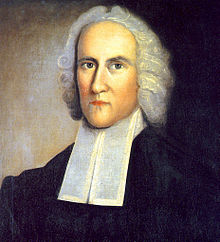
The works of Jonathan Edwards were reprinted in the 1970s-80s. This reprinting had a huge impact on Christian thinking.
Edwards believed that God is literally the direct cause of every single thing in the universe, and God causes all of it for his glory. And to deny that this is true, for Edwards, means to deny God altogether.(1)
God's causation of all things includes evil. God causes man to do evil. All the rapes, murders, genocides--everything evil under the sun was caused by God through man for His glory.

So, in this view, not only did God only choose to save some and not others, but he is also the direct cause of the evil that the reprobate commit. On top of that, God causes them to be punished for those sins forever and ever. God causes men to sin and then punishes them for the sin that he caused them to commit.

And somehow this is, on a general level, okay with Christians.
In fact, Edwards is considered "one of the most important theologians of American evangelicalism."(2)

Rob Bell, on the other hand, merely suggests that maybe people can come out of hell in the next life.

First, I need to make it clear that nowhere does Bell ever say that hell does not exist:
"Do I believe in a literal hell?
Of course.
Those aren't metaphorical missing arms and legs."(3)
Bell merely suggests that hell could be "'a period of pruning' or 'a time of trimming,' or an intense experience of correction."(4) 

He alludes to the idea that hell could be a refining fire, burning the sin and corruption off of the sinner so that he can die "the kind of death that actually brings life."(5) 

That's it. He doesn't take any of the horror out of hell; just the forever and ever.
When Christians hear this, they freak out.
They call him a heretic. They say he simply cannot be considered a Christian. They suggest that he is "New Age."(6)

This is not a defense of Rob Bell's Love Wins.(7) Rather, I am proposing a question.


The question is this: 

What is it about Christianity today that is okay with the idea that God directly causes all of the evil in this world, that he causes humanity to sin and then dooms them to torment in hell where they will be tortured every day, 7 days a week, 12 months a year, 100 years a century, century upon century--and he is glorified by all of it; yet, Christianity today will immediately, ruthlessly reject--with passion--the idea that hell is a refining fire that purifies the sinner of his corruption and evil?

What is it about Christianity that is okay with God being the cause of the evil and torment of billions of people, but is totally not okay with God bringing people out of hell? 

I would like to add that George MacDonald, who inspired C. S. Lewis and is a highly respected Christian theologian, believed the exact same thing.
Also, Origen, one of the church fathers, believed not just that God would reconcile the inhabitants of hell back to him, but that eventually God would reconcile even the devil and his demons back to heaven.   
 

Notes:
(1) See Roger Olson, The Story of Christian Theology: Twenty Centuries of Tradition & Reform (Downers Groves: InterVarsity Press, 1999), 506-507.
(2) Ibid., 509.
(3) Rob Bell, "Hell," in Love Wins (New York: HarperCollins, 2011), 71.
(4) Ibid., 91.
(5) Ibid., 77.
(6) This statement is absolutely false. The New Age movement is very out-of-the-box magic stuff light-years away from Christianity. It has to do with Shamanism and a lot of weird crap. People tend to associate New Age with anything that reinterprets Scripture. This is absolute ignorance and just shows that they don't know what they are talking about.
(6) I do not actually agree with Bell. However, I do think it is good that he is raising the questions (whether or not they were raised in the right manner is the question). And I do think his view holds water and is a possibility. I don't think there is anything wrong in his believing it, but I personally do not.