The Blog of Jack Holloway
Showing posts with label Heaven. Show all posts

Monday, September 23, 2013

Part II of "What makes you doubt Christianity?"

Here are the contributions I received from the original blog (here). I respond to some of them with reflections and/or suggestions for what to study. If you would like to contribute, please email me at johndanielwashere@gmail.com. 

The tension between law and grace, faith and works.
I've struggled with this one before, and have written on it here. One has to shed a lot of what Luther read into the text in order to come to terms with the seemingly contradictory statements regarding Christian life in Scripture. Christianity is about living the kingdom of God, embodying the reality that Jesus accomplished on the Cross. Thus, works consist of our active participation in the kingdom of God, in Christ's reality. The law is not made up of rules, but ways we can apply the kingdom to our lives. It is easy to turn this into legalism, but that's when we start regarding Scripture as a rule-book.
It's hard to deal with/love fundamentalists and/or people who believe and teach damaging doctrines.

How patriarchal the Bible mostly is.
One major consideration needs to be made when dealing with this issue: context. It also needs to be addressed on a text-by-text basis, and often simply considering the historical context will remedy the problem. There are so many good books on this topic. Why Not Women? is one that was highly recommended to me, but there are many others. That would be a good place to start. For an assessment of one text, see my, "Does Genesis 2 Support Complementarianism?" (here). It should be said, though, that the "patriarchal nature" of Scripture is often over-stated. In many places, the Bible is quite woman-exalting.
Most Christians are so certain of what that they believe that they never question it. A great many Christians do not engage in critical thinking.

Christian hypocrisy and self-righteousness, manifested in things like treatment of/talk about homosexuals, or people of other religions.

What about those who have never heard the Gospel?
I can see this one being very hard for Calvinists, but it isn't hard for me at all. While it is unfortunate that so many people in history, as well as in our time, are not subjected to the Gospel, if one affirms a great wideness in God's merciful saving love, we can feel at peace about this issue. I have written about this here. A good book to look at on this is A Wideness in God's Mercy by Clark Pinnock, as well as those cited in my blog on the subject.
"I know my level of intelligence and understanding and there are a lot of better equipped thinkers out there who do not believe what I believe. So I wonder, who am I to think this stuff is true?"

Prayer. How come some prayers are answered but most aren't? How come someone's headache is healed, but someone else's cancer isn't? Don't we serve an all-powerful, all-loving God? Why wouldn't he heal everyone if he could?
I have some pretty bad back and neck problems that I wake up with every single morning, so this was something I struggled with for a while (and still do, depending on how bad I feel on a particular day). I have written on the subject here, "Petitionary Prayer: What is it Good for?", but I also recommend Greg Boyd's book Is God to Blame?, as well as his chapter, "Praying in the Whirlwind" in Satan and the Problem of Evil. Vincent Brummer's What Are We Doing When We Pray? is another good one. There is a lot of really good literature on this topic, but those are good places to start, as well as the works cited in my blog.
The problem of evil and suffering. It is difficult to reconcile God's benevolence with the existence of things like cancer and AIDS.
All honest Christians struggle with this at one point or another. While I have read a lot on the subject, I can think of no better person to go to than Greg Boyd. Specifically, his book Satan & The Problem of Evil. If you're really into the topic, supplement it with his God at War. For a shorter, easier read, see Is God to Blame? There are tons and tons of books on this topic, but Boyd would be the perfect person with whom to start.
Pluralism. If I were born in other parts of the world, I would not be a Christian. Do I think Christianity is true simply because of my context? How can I be so bold as to claim that the religion I follow is THE truth? There are thousands of religions all over the world, and plenty have their holy books, what makes Christianity so special?
This is an issue that is often daunting to me, and very humbling when I speak of things that I 'know'. For me, this is where the rubber meets the road, faith-wise. I wrote a personal reflection on pluralism here, saying that, in the end, one has to look at the subjective truth claims of this world and ask oneself, "Which one is more worthy of my faith?" because we can't know that Christianity is actually true.
Angels and Demons, Heaven and Hell. They seem so make-believe, as if they were made up to deal with death.
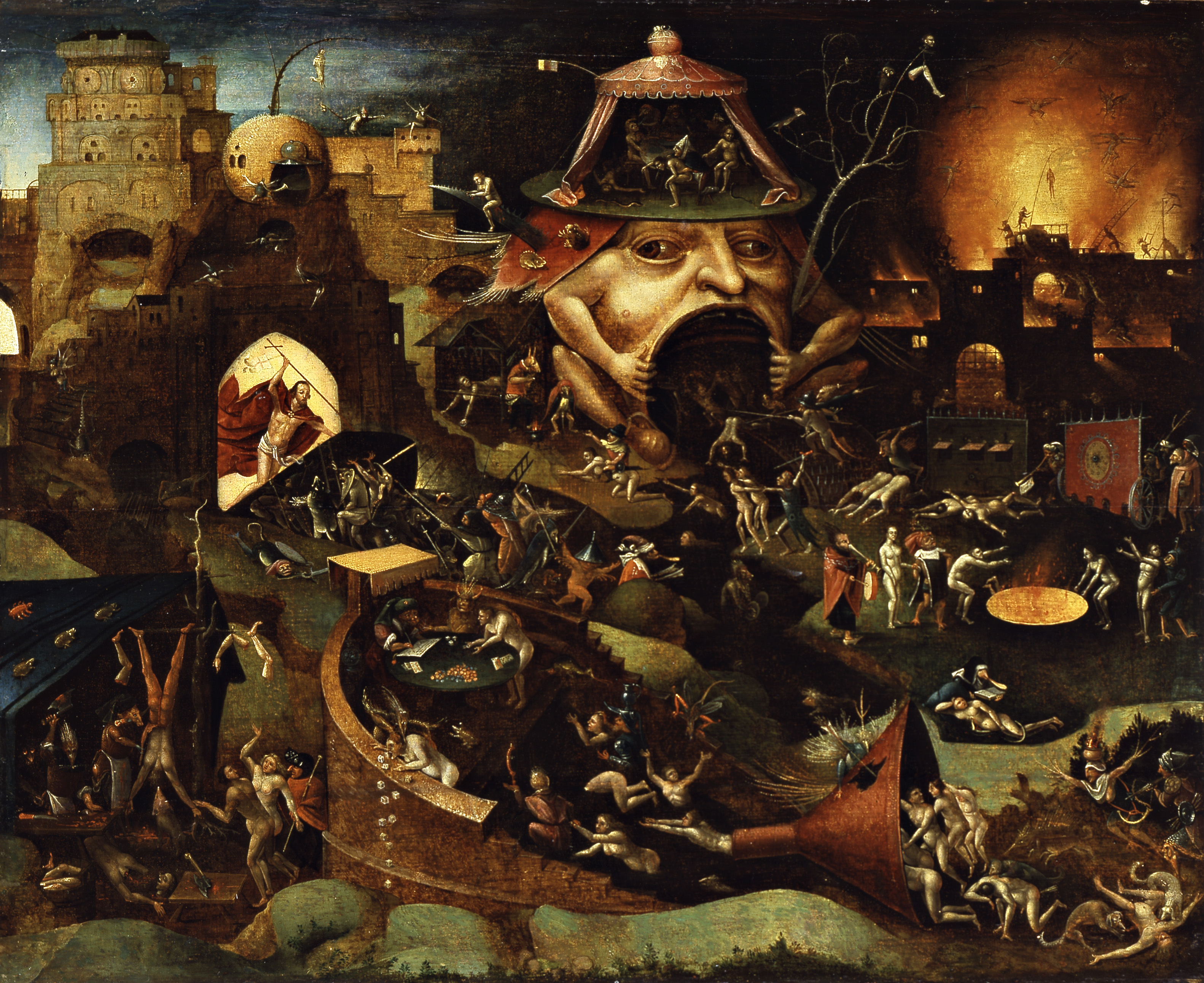
This is a tough one. What makes it worse is how angels, demons, heaven and hell have been portrayed over the years. We tend to have a shared concept of angels as winged, effeminate and covered in white; demons as ork-like or dragon-like beasts; heaven as a golden city in the sky; and hell as a fiery pit with black castle-like buildings, where people are tortured by demons. I have tried to re-word these terms in an effort to steer away from these preconceived ideas--using terms like "metaphysical" instead of supernatural, forces of chaos, instead of demons, and others. Sometimes, when words have been ascribed images that make them ridiculous, we just have to come up with new ways of referring to them.
Another thing that helps me is to recognize the signs of their existence in the world. We have desires that go beyond our experience, that go beyond what we can satisfy. We have urges to do horrible things sometimes, and we often don't know why we do such things. Sometimes things happen that can only be sufficiently explained by divine hands (I find all other "natural" explanations dissatisfying). Other things can only be explained by an actual force of evil at work--attributing the misfortunes in nature to the trial-and-error process of evolution isn't going to do it for me. I can think of many examples, but you get where I am going. There are signs in the world around us that point us beyond, and affirm what we see in Scripture.

Monday, March 25, 2013

Universal Reconciliation Q&A

"I have reason to believe we all will be received in Graceland."
Paul Simon

I recently wrote a blog (here) advocating the doctrine of universal reconciliation. I knew there would be plenty of challenging questions in response, so I wanted to take some of them and respond to them here.

(I want to add to this, so please send me a question if you've got one to add.)

Yes, God is love, but he is also just. Though he wants all people to be saved, he also desires justice.

I have a few things to say in response to this.

First, universal reconciliation doesn't remove justice from the picture. Was justice not served when the prodigal son ended up fighting with pigs over food after demanding his inheritance and abandoning his father? In the same way, justice will be served when those who have chosen Hell on earth will get what they wanted. God's wrath is letting them have it (click here for a more thorough explanation of this view of God's wrath).

Secondly, what happened when the prodigal son returned?
In that day, it would have been the custom to make the son sit outside the home for days to prove that he was genuine in returning home. But when the son in the story returned, was the father so concerned with justice that he made him do this? Or did he run out to him (in that time, N. T. Wright provides, running was thought to be "undignified")(1) and embrace him? Did the father stop his son and ask him all kinds of questions to see if he was worthy of returning?

The son had a whole speech planned, and in it he was merely going to ask the father if he could become a slave in his house. The father wouldn't have it. He was just so happy that his son was returning.
Does this seem like a father that is super concerned about justice when it comes to his children?
Many say universal reconciliation is too human, but in this case, even the son himself was only expecting to be made a slave! In this case, the human version of justice wasn't good enough for God!

Finally, Jesus is a testament to the fact that [human perception of] justice is not God's main concern. He says something very interesting in John 12: "If anyone hears my words but does not keep them, I do not judge that person. For I did not come to judge the world, but to save the world" (v.47; also see Jn. 3:17). He then adds, "The one who rejects me and does not receive my words has a judge" (v.48). He is implicating God the Father here (see vv.49-50). However, elsewhere Jesus tells us that "the Father judges no one, but has entrusted all judgment to the Son" (Jn. 5:22). So, the Father is not the judge, but hands judgment over to the Son, and the Son does not come to judge the world but to save it! Yes, there is judgment. Yes, there is justice. But "mercy triumphs over judgment" (Jas. 2;13). Ultimately, God's purpose is to save the world and not condemn it forever and ever, so Jesus will have mercy on those who reject him in this life. Timothy Jennings says beautifully, "biblical justice is delivering the oppressed, not punishing the oppressor!"(2)

(I elaborate more on this topic in another blog, here)


Can't "all people" simply refer to all races, cultures, and groups rather than literally every single person who ever lived?

In some cases, you can look at it that way, like when it says "all nations" or "all the ends of the earth." However, it is not more valid to interpret it this way. For other verses, I don't think you can avoid it by saying that it refers to all kinds of people. For example, when Psalm 65:2 says all people will come to God, the Hebrew words there don't mean, literally, "all flesh," same as 145:21.

In John 12:32 and 1 Cor. 15:22, the Greek text doesn't actually say "all people," but only says "all," and the Greek word for all literally means all, every kind of, each and every one, the whole.
 I don't see how you get past that.

If the Greek and Hebrew words for "forever" don't actually mean forever, wouldn't that also mean that God's love doesn't have to go on forever, since the same words are used to describe God?

I get this one a lot. It's a good point, but it stops short of disproving universal reconciliation because of two things:

1) I didn't say the Greek and Hebrew words for eternal can't mean forever. The reason these words don't have to mean forever is because they don't refer to an actual duration of time, because the biblical writers didn't think about forever and ever. They thought in generations and ages. Hell and God are similar in the sense that they are both beyond ages and generations, and their ends are not in sight to humans. When it says God's steadfast love goes on "forever and ever," it's really saying that it goes on and on and the end of God's love is not in sight.

I know what you're thinking. Wouldn't that mean that God's love can end?
No, and this leads to my second point:

2) These are not the only words used to describe God. Other words were used to describe God's everlasting characteristics. For example, God's love is said to never end. Nowhere does it say that Hell will never end.

Consider this illustration: the sun is huge.  Its circumference is 2.715 million miles long. We use words like enormous, gigantic, and humungous to describe how big the sun is, because it's so big we can't actually conceive of how big it is. The universe is also  enormous, gigantic, humungous. It goes on for billions upon billions of light years.

While the sun is enormous, it does have an end. The universe doesn't (well...maybe it does, but I'm not going to get into that; you get the point). Likewise, how long God lasts and how long Hell lasts can both be said to be olam or aion, it can also be that God can last forever while Hell ends at some point, because the words used to describe them doesn't actually specify a duration, just like the word humungous doesn't specify an actual size.

I should also add that this problem with these Greek and Hebrew words still comes up no matter what you believe about Hell. The Hebrew word olam (which is "supposed" to mean forever) is used by Jonah to describe how long he was in the belly of the fish (2:5-6). If it can be used to describe a period of 3 days, this word clearly doesn't have to mean forever.

If Hell is not forever, wouldn't that demean the atonement?

Maybe it would, if the only reason Christ died on the Cross was to save people from an everlasting Hell. But I don't believe this was the only reason, nor do I believe that this is the central reason.

Christ died on the Cross so that God could be in an intimate relationship with his creation. Throughout the Old Testament, God is trying everything he can to be in relationship with his people. All of human history is God in search of man. Jesus is a continuation of that story. The Cross is the greatest point in human history where we can see God in search of man, and I believe that story will continue even after death.

The atonement is many things. Let's not make it just about saving humanity from a never-ending Hell. It's so much more than just that.

I should also add that the doctrine of universal reconciliation doesn't take any of the horror out of Hell. One of the reasons for the atonement was still to save people from the horrible place in which they would experience all the consequences of their own sinful choices. It's not like Hell is any less terrible because it doesn't last forever and ever.

Consider this illustration: let's say all of humanity signed up to get addicted to cocaine at a certain point (it's a silly example, but sin is also silly). When God saw this, he sent Jesus to give them a way to avoid this doom. Some didn't accept his invitation, so they still headed to cocaine addiction. Sure, there's always rehab, but forcing oneself to submit to rehab while addicted to cocaine is incredibly hard, and the process of rehab isn't any easier. It doesn't take a Christian to tell someone to avoid cocaine. Why do most people avoid it? because they know that, though it promises euphoria, it leads to a terrible experience of which it takes what feels like a lifetime (here would be a good place for the word aionios) to break free.

Hell, like a cocaine addiction, is an awful fate no matter how long it is. Thank God he gave us a way out!

Isn't universal reconciliation an altered form of Calvinism's irresistible grace? Wouldn't the idea that God will eventually win all people over contradict free will?

I have a few things to say in response.

One, I am not saying that as long as there is a Hell, God is going to be turning up the heat, if you will, on his love so that he will become irresistible to people. I am saying that as long as there is a Hell, God is going to continue to do everything he can to save people from it. But as long as people have free will, they can reject him.

I will use an example to illustrate my point: let's say I find out that my friend Matt hates me. I can choose to ignore that fact and go on living my life forgetting that I love his friendship. But I do love his friendship, so instead I pursue him and am absolutely determined to find reconciliation. If I finally get to the point where Matt chooses to be my friend again, it wouldn't be because I overrode his free will, but because I pursued him long enough. In the same way, whenever God finally reconciles all people to himself, it will not be because he obliterated their free will with his love, but because he pursued them long enough.

Two, forever is a very long time. I don't think the day after judgment day God is going to win everybody over. Some will insist on Hell for a very, very long time. I just don't think God is ever going to stop pursuing those people.

Three, what I stress in universal reconciliation is not that everyone is going to be saved, but that God is never going to stop pursuing people. I stress this because I have no idea when everyone is going to be saved, and if it weren't for Scripture, I wouldn't believe it. It is because Scripture tells of a day when all people, all flesh, everyone will come alive and worship God that I believe that some day God will succeed in drawing all people to himself.


Have a question to add? Send it to me! 

Notes:
(1) N.T. Wright, After You Believe (New York: HarperOne, 2010), 12.
(2) Timothy Jennings, The God-Shaped Brain (Downers Grove: InterVarsity Press, 2013), 188.

Tuesday, March 19, 2013

Is God a Universalist?

"I am not a universalist because there are some people that I don't want to see again. But God may be."
Jurgen Moltmann

Which Universe Do I Live in?

Before I get into a defense of Universalism, I should clarify which form of Universalism I am defending.

I don't believe that all roads lead to God, or that it doesn't matter how people live in this life because they will all be in Heaven when they die. Nor do I deny the existence of Hell.

I believe in Universal Reconciliation, which states that as long as there is a Hell, God will be trying to reconcile all of its inhabitants back to himself. In this, Jesus is the one way to salvation, but eventually everyone will choose to say Yes to him.

Is Universalism in Scripture?

Any Bible-believing Christian must at least recognize that Universalism is something God wants.

1 Timothy 2:4 says that God "wants all people to be saved and to come to a knowledge of the truth."

We are told in 2 Peter 3:9 that God "is patient with [us], not wanting anyone to perish, but everyone to come to repentance."

Similarly, in Ezekiel 33:11, God says, "I take no pleasure in the death of the wicked, but rather that they turn from their ways and live." So, at the very least, Unversalism sounds just as wonderful to God as it does (or should) to us.

But can we go further than that and say that all people will actually be saved?

The Psalmist of Psalm 65:2 says to God, "to you all people will come."

Psalm 86:9 says, "All nations whom you have made shall come and worship before you, O Lord, and they shall glorify your name."

Psalm 145:21 says, "all flesh will bless his holy name forever and ever."

Isaiah 2:2 says that "all nations will stream" to "the mountain of the LORD's temple."

Then, in 52:10, we are told that "all the ends of the earth will see the salvation of God."

Jesus says in John 12:32 that "when I am lifted up from the earth, I will draw all people to myself."

Paul tells us in 1 Corinthians, "as in Adam all die, so in Christ all will be made alive" (15:22).

He tells us in Philippians that, "at the name of Jesus every knee will bow, in heaven and on earth and under the earth, and every tongue acknowledge that Jesus Christ is Lord" (2:10-11).

The writer of Hebrews quotes what God revealed to the prophet Jeremiah, that "No longer will they teach their neighbor, or say to one another, ‘Know the Lord,’ because they will all know me, from the least of them to the greatest" (8:11).

So it appears there are actually several places throughout Scripture that support Universalism. How then do we reconcile these verses with verses that talk about Hell?

Is Hell Forever?

The Greek and Hebrew words that are translated 'forever' or 'eternal' or 'everlasting' do not actually fit the description of these English words. The Hebrew word olam and the Greek words aion and aionios do not have specific durations. They do not mean "absolutely unending."

They denote time-independence, describing an age that is not bound by time and cannot be measured. It cannot be measured because the end is not known or in sight. These words mean "until the vanishing point" or "beyond the horizon."

The punishment one experiences in Hell is described in Scripture as something that is perpetual, ongoing. However, its actual duration is unknown. Thus, it does not have to be taken to mean forever.

And why should we limit God to that one thing? Why limit God to "All unrepentant sinners will go to Hell when they die and will be there forever and ever"? Does this not make us like Jonah, who, after he prophesied to the Ninevites, sat and waited for God to destroy them? He limited God to that one option. But God, when he "saw what they did and how they turned from their evil ways, he relented and did not bring on them the destruction he had threatened" (Jon. 3:10).

Forever is a long time. Why decide for God that billions of years from now he is still going to be in Heaven thinking, "Yah, they still deserve it. I'll let them continue to suffer"? Why not let God decide how long Hell is going to last? This is what the biblical writers did. The words they used implied that people would be punished but they left the end of that punishment up to God.

Is God a Universalist?

The parable of the Lost Sheep is one of the most powerful explanations of the Father's heart that we have in Scripture. Every time I read it, I see something new and experience a little piece of the Father's love in the most magnificent way.

As an aspiring theologian, I often think about the theological implications of this parable. What does it tell us about God? Recently I have asked, what does it tell us about God and the doctrine of Hell?

But before we go there, let's look at some other parts of Scripture that tell us about the character of God.

Psalm 30:5 tells us that God's "anger lasts only a moment, but his favor lasts a lifetime."

It is revealed in 1 John 4:16 that "God is love" and in 1 Corinthians 13:8 that "Love never fails."

Similarly, in Lamentations 3:22 we are told that "the steadfast love of the LORD never ceases; his mercies never come to an end."

A few verses later, we are told that "no one is cast off by the Lord forever. Though he brings grief, he will show compassion, so great is his unfailing love" (vv.31-32).

This is similar to what James says, that "mercy triumphs over judgment" (2:13).

God tells us in Malachi 3:6, "I, the LORD, do not change."

Simarly, James tells us that "there is no variation or shifting shadow" in the Father of Lights (1:17).

So, now let us return to the parable.

God is the kind of God that leaves the 99 sheep to rescue the 1 that ran away (Lk. 15:4-7). He searches for it "until he finds it" (v.4). And "when he finds it" (v.5), he rejoices and throws a party. This is God's attitude toward sinners who run away from him.

Let us put these pieces together.
God is love. God's love never fails. (The Greek words that are used to describe punishment after death do not have to mean forever, but the Greek and Hebrew words for never are quite clear.) Though his anger comes, though he brings grief, mercy triumphs over judgment. He will show compassion because his love is unfailing. 

This is the way God is. He does not change. Though we are inconsistent, God remains the same.

What about after people die? Does God stop being the God who leaves the 99 to rescue the 1? Does his love cease? Does he stop trying?

In the Old Testament, God struggles with his people. He often threatens destruction and brings punishment, but he always ends up bringing restoration and promising ultimate reconciliation and victory. This is because, as Abraham Joshua Heschel says, "God does not delight in unleashing anger"(1) but, rather, his anger is used "to bring about repentance; its purpose and consummation is its own disappearance."(2) Ultimately, he pours out his love on his people; "It is a love that transcends the most intense anger, a love that abides in full recognition of human weakness."(3)

In the New Testament, this is beautifully revealed through Jesus, who tells us that God is not indifferent to sinners, but searches for them until he finds them. He runs to them when he sees them and embraces them as much as he can, knowing that when they sin and run away "they know not what they do" (Lk. 23:34).

Will this change once they die? Or will God keep seeking sinners even after they have chosen Hell?

Heschel said that, "All of human history as described in the Bible may be summarized in one phrase: God is in search of man."(4) I don't think this is a search that will ever end until God finds all of his creations and can embrace all of them.

So how do we reconcile the Universalist parts of Scripture with the Hell parts? We can affirm both. Yes, people will go to Hell if they choose it with their lives now (click here to see my blog about the nature of Hell for more explanation).

But, eventually, it will be that all people will come to God, all people will worship and glorify and bless his name, all nations will stream to his temple and experience salvation, all people will be drawn to Christ, all will be made alive in Christ, every knee will bow and every tongue will confess that Jesus is Lord, and everyone will know him.

Yes, I think God is a Universalist.


Notes:
(1) Abraham Joshua Heschel, The Prophets (New York: HarperCollins, 2001), 369.
(2) Ibid., 367.
(3) Ibid., 380.
(4) Heschel, God in Search of Man (New York: Farrar, Starus and Giroux, 1983), 136.

Saturday, August 11, 2012

Bane and Hell: Tortured with Hope


“But my people did not listen to my voice,
And Israel did not obey me.
So I gave them over to the stubbornness of their hearts,
To walk in their own devices."
                                         - Psalm 81:12
"Professing to be wise, they became fools, and exchanged the glory of the incorruptible God for an image in the form of corruptible man and of birds and four-footed animals and crawling creatures. Therefore, God gave them over in the lusts of their hearts to impurity . . . God gave them over to degrading passions . . . God gave them over to a depraved mind."
                                                                                                - Romans 1:22-24, 26, 28
The Power of Choice

There is something horrible that happens to humans when they become so full of sin that they reject God completely and insist on going their own way--God lets them go. I am speaking of Hell.

With our beliefs and actions, we either say 'Yes' to God or we reject him. Or to speak eschatalogically, we either choose Heaven or Hell. As Oscar Wilde's Dorian said, "Each of us has heaven and hell in him."
One cannot go to Heaven if he has rejected God.

No matter how much God wants everyone to go to Heaven (Ez. 33:11; 18:31-32; Matt. 18:14; Tim 2:4; 2 Pet. 3:4), if people reject God and choose Hell then that is their decision and God cannot override that. He cannot violate someone's free will by bringing them up to Heaven when they have chosen Hell with their thoughts and actions.

As Rob Bell wrote in Love Wins, "God gives us what we want, and if that's hell, we can have it. We have that kind of freedom, that kind of choice. . . . We can have all the hell we want."(1)

And as C. S. Lewis wrote in The Great Divorce, "All that are in Hell, choose it. Without that self-choice there could be no Hell."(2) 

HELL

But what is Hell? Is it a place to which God sends people? Is it a place where people are tortured for their sins? Will it be like in the movies where the hero finally gets to the villain and beats him saying something like, "This is for what you said about my wife, and this is for what you did to my car!" I don't think so.

I think it will be a place where people "walk in their own devices," where people pursue impurity "in the lusts of their hearts," where people are full of "degrading passions" and live in a "depraved mind." 

Requiem for a Dream is a movie about people who get addicted to drugs and, as a result, their lives spiral into shocking, tragic hells of horror and despair. The Lost Weekend is a movie about a guy who is addicted to alcohol and this addiction ruins every part of his life and leaves him in a hell where there is no comfort, only sadness and even terror. Shame is a movie about a guy who hates himself so much because of an addiction to sex. He finds himself in a hell where "sex is his cross to bear"(3) because he finds no pleasure in it, but always feels the need for it.

"People choose to live in their own hells all the time," says Bell.(4) I think Hell will look like this. As Martin Luther said, "sin is the punishment of sin."(5)

About a week ago, I went to watch my fiancee perform in the play Eurydice. In it, the main character, Eurydice, dies and goes to "the Underworld"--Hades (the play is a modernization of a Greek myth). At one point it is referred to as Hell but that's not an accurate title given what our culture understands Hell to be.
Anyway, the "Lord of the Underworld" said something I found very interesting. He said, "We make it real nice here, so people want to stick around."

Though the Underworld in this play (and in the Greek myth) is simply the place where people go when they die rather than the alternative to Heaven, this statement is very telling of what I think Hell really is.

I am not trying to say that people are comfortable in Hell. I just think people will pursue pleasure in Hell the same way they do in life. Except, like the character in Shame, there is no real pleasure in it.
What else does this craving, and this helplessness, proclaim but that there was once in man a true happiness, of which all that now remains is the empty print and trace?
This he tries in vain to fill with everything around him, seeking in things that are not there the help he cannot find in those that are, though none can help, since this infinite abyss can be filled only with an infinite and immutable object; in other words by God himself.
                                                                                                              - Blaise Pascal
People on earth try in vain to fill the infinite abyss inside them with everything they can find, "seeking in things that are not there the help [they] cannot find in those that are, though none can help." We can see this all of the time. A perfect example is from Woody Allen, who said in a recent interview,
When I look back on my life, I’ve been very lucky that I lived out all these childhood dreams. I wanted to be a movie actor, and I became one. I wanted to be a movie director, and a comedian, and I became one. I wanted to play jazz in New Orleans, and I played in street parades and joints in New Orleans and opera houses and concerts all over the world. There was nothing in my life that I aspired toward that hasn’t come through for me. But, despite all these lucky breaks, why do I still feel like I got screwed somehow?(6)
As I said in a past blog, all people have fires in their hearts and they are constantly trying to find water to put out their fires. What they use, however, is oil labeled "Water" that only makes the fire worse. This is exactly what I think people will be doing in Hell. And this, I think, is much more terrifying.

BANE AND HELL

In The Dark Knight Rises, Bane describes a prison in which he spent most of his life. The prison is underground and there is a well-like structure that reveals the world above (see the picture at the top). Prisoners frequently try to climb out, but it is much too tall and treacherous for them to make it.  

Bane says, "There's a reason why this prison is the worst hell on earth: hope. Every man who has ventured here over the centuries has looked up to the light and imagined climbing to freedom. So easy, so simple. And like shipwrecked men turning to sea water from uncontrollable thirst, many have died trying. I learned here that there can be no true despair without hope."

Bane might as well be describing Hell itself. Hell's inhabitants will be tormented with the need and desire to put out their fires, to fill their infinite abyss. The impurity they pursue in their lusts and degrading passions will be their hope. Indeed, like Bane, it will claim "I am necessary evil." It will promise fulfillment, but will not deliver. "You think the darkness is your ally?" It is just oil labeled 'Water.' It will just make them worse, as more drugs, more alcohol, and more sex make the drug addict, the alcoholic, and the sex addict worse. "The shadows betray you, because they belong to me." All the while, they will be tortured with the hope that the next dose will satisfy them. "Hope is really the key to torture." They will be slaves to this disposition; it will overcome them and control them. "Do you feel in charge?" This is what it means to be led by a "depraved mind." Nothing will satisfy them, because the "infinite abyss can be filled only . . . by God himself."

HEAVEN

Heaven is exactly the opposite. For one to be in Heaven, one would have to completely die to the passions and desires of one's self--that is, one's focus on fulfilling the self. One would have to lose his life. In this dying is life. In this losing is the finding of truth.

"Now those who belong to Christ Jesus have crucified the flesh with its passions and desires."  (Gal. 5:24)

"Truly, truly, I say to you, unless a grain of wheat falls into the earth and dies, it remains alone; but if it dies, it bears much fruit." (Jn. 12:24)

"He who has found his life will lose it, and he who has lost his life for My sake will find it." (Matt. 10:39)

In The Great Divorce, a ghost from Hell talks to a "solid spirit" in Heaven whom he knew as a human on earth. The solid spirit had murdered a man on earth. The ghost was baffled that the murderer went to Heaven and, when the solid spirit told him there was no need to bother about it, the ghost asked him, "Aren't you ashamed of yourself?" "No," said the solid spirit, "I do not look at myself. I have given up myself."(7)

Christ is our image of God, and he gave himself up for us. The Trinity is a union of self-sacrificing, self-emptying love. To be in Heaven would mean to be transformed into a state of this love. In this, we give up ourselves. We give up seeking to fulfill our infinite abyss. But, paradoxically, in dying to the passions and desires of our flesh, in giving up our focus on self-fulfillment, in losing our lives, we experience the fullness of the truth and we find life. "For if we have become united with [Christ] in the likeness of His death, certainly we shall also be in the likeness of His resurrection . . . for he who has died is freed from sin." (Romans 6:5,7)

In this, there will be no fire to put out, for we will be engulfed in an Ocean of transforming love. Rather than seeking to fill up our emptiness, we will be whole vessels of God's self-sacrificial, self-emptying, other-focused love!

I will conclude with a reminder:

Our job as disciples of Christ is to make people aware of the Ocean of God's love that can put out their fires. We are to dive into that Ocean and invite everyone to dive in with us.

Our job is to introduce them to the universal salvific love of Christ. The love that transforms. The love that fulfills. The love that satisfies.

Everything I've been describing about Hell is an absolute tragedy. It should inspire nothing but sadness in our hearts as Christians, because it inspires nothing but sadness in the heart of God.

Let us join the trinity in holding out our arms toward the lost. Let us be extensions of Trinity love--self-emptying, other-focused, compassionate, peacemaking, life-transforming. Let us lay down our lives for the lost, for no greater love is there (Jn 15:13).

Notes:
(1) Rob Bell, Love Wins (New York: HarperCollins, 2011), 72 and 113.
(2) C. S. Lewis, The Great Divorce, (New York: Macmillan, 1946), 72.
(3) This was the title of Roger Ebert's review of the film.
(4) Bell, 114.
(5) Martin Luther, quoted in Anthony Tyrrell hanson, The Wrath of the Lamb (Eugene: Wipf & Stock, 1957), 17. 
(6) Woody Allen: A Documentary, directed by Robert B. Weide, Whyaduck Productions, 2012.
(7) Lewis, 27.