[Read Paul's response to John Daniel's blog here]
Paul,
I think my assessment does apply to authorial intent, because I think the author of the narrative's intent was to take ancient Near Eastern myths and use them to point to Yahweh, the incomparable one true LORD God.
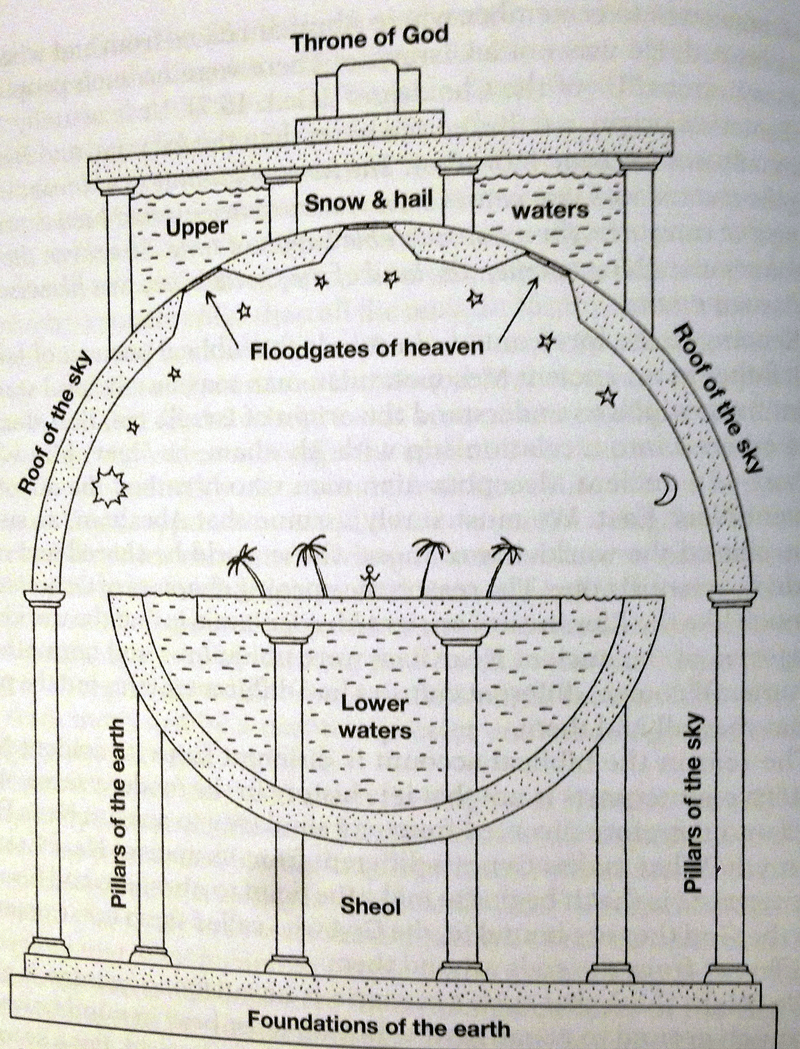
To your question that I may be excluding divine revelation in the text by denying the narrative's literal history: I think the logic here is a little funny. We have to receive books of the Bible for what they are: Psalms, Proverbs, Song of Songs, Job--these are books that have to be received certain ways, and cannot all be treated the same way. When you say I could be excluding divine intention by denying the creation accounts any literal history, you're assuming the creation narratives might have actually been written to record literal history. When you study whether or not this is the case, it becomes obvious that that was not the author's intention at all. I am not going to make a full case for this claim, but I'll provide a couple examples to make the point: The Genesis creation accounts use mythical images that pre-date Genesis by hundreds of years. Also, the ancient Near East, including the Jewish people, believed in a structure of the world that we know now not to be true. For example, the sun, to them, was the thing that moved, not the earth (see Josh. 10:12; Ps. 104:5; 19:6; Ecc. 1:5, to cite a few). The picture above is an illustration of how ancient Israelites viewed the cosmos (I took the picture with my iPhone, it comes from Peter Enns' book Inspiration and Incarnation, haha).
These examples show that Israelites did not have a perfect understanding of the universe and how it operated/came into being. And why would they? These are ancient people who had nowhere near the scientific data that we have today (and I'm not just referring to evolution; I'm also referring to the earth's rotation around the sun, the fact that the earth is a sphere, the fact that the earth is not made up of a big piece of land surrounded on all sides by water, and others). Why should we expect ancient Israelites to know things they would have no way of knowing? Because they received revelation from God? Why was it important for God to tell them how the universe actually operated? Such issues were not concerns for them.
Oh, I get it; it's because the Bible has God as its ultimate author, and if he wrote things about the universe, then they have to be true. Well, a lot of the Bible is not going to make a lot of sense until we divorce ourselves from this concept. Not only is the belief not necessary, but it is nowhere taught by Jesus, or anyone else in whose authority we put our faith. My problem with inerrantists is that they expect way too much from the Bible. They are not realistic about what the Bible actually is, and in an attempt to make Scripture something in which people can put their faith, they over-step and make it out to be something it was never intended to be. Once you look at all the evidence, it is, in my mind, impossible to go
return to the view that the creation accounts record actual history. If your view of Scripture doesn't allow for that possibility, I think you're expecting too much from the Bible, and not being very realistic about what it actually is.
There's my rant for today. Haha.
You asked, What is the purpose of attempting to show that the Genesis account is not completely unique? (I like your use of 'attempting'). The point of doing that was to set the stage for the purpose of my post, which was to show how Yahweh is unlike the gods of the ancient Near East. I wanted to show that the Genesis accounts are up to their neck in the ancient Near Eastern culture, so that I could point to the author's intent, which I think was to present the incomparability of Yahweh to an ancient Near Eastern people.
I wish you would have expanded on your claim that my open theist views were making their way into my interpretation of the text. You didn't give me an example. Maybe, if you had, I could have explained to you why the text leads me to make such a claim; or, maybe there was something with which I could admit that I was taking poetic license with the text (which is not impossible!).
I can see that, in a mythical reading of Genesis 2, it would seem odd to claim that the human participated in God's creation of the world. "Wait, doesn't he deny that this is actual history? What is he saying?" I think the narrative points to the reality that we were created to help bring creation forward. We were created to care for the earth, to procreate (which literally consists of humans participating in God's creative activity), and to reign over it. My point was that humans are the gardeners with God in the Garden of Eden, which symbolizes our duty to care for creation and help bring it forward. It also points to the power that God has given humanity. That the human in the creation narrative participates in the creative activity of God shows that God invited humanity to play a significant role in the production of human history.
When I said that God doesn't always get his way, I was pulling from Genesis 3. He gave them a command (which implies that they have the power to oppose his will, because his will is for them to follow his command) and in chapter 3, they break the command, opposing his will. Again, clearly this is a God that doesn't always get his way.
I find your comments on God's self-glorification...odd, to say the least. You're comparing God's self-glorification to selfies on Facebook? While I applaud you for realizing that the doctrine of God's self-glorification implies narcissism (or maybe your comment doesn't go that far), I find it funny that you don't see this as a problem. Do we really serve an ego-maniacal, self-obsessed God?
Also, your assessment of God creating humanity in his--or, better, their--image is presumptuous. The text does not imply self-glorification. God says, "let us make mankind in our image, in our likeness" (1:26). Christians can apply the Trinity to this statement, but even without the doctrine of the Trinity, a better (but not necessarily correct) interpretation would be that humans were created in the relational image of God, in which it is not good for us to be alone (2:18). But even if you don't like this interpretation, self-glorification is not in the text. God could be being narcissistic when he says "let's create humanity to be like us," but this is not at all necessary. If we do apply the doctrine of the Trinity to this scene (and why shouldn't we?), it would be much better to say that the Trinity wanted to create more participants in their relation of love. After all, God is love, so if God is to make humans in his image, love will be at the front of the list; and not love of self (if God is narcissistic, doesn't that imply that we should be the same way?), but other-focused love, Trinity love.
Finally, while I do think we should worship God, you impose on the narrative when you assert that there should be an emphasis on the human's call to worship God in an assessment of Genesis 2. Nowhere in this narrative is that call made.
Paul, this has been a lot fun. We should try to think of something else on which we can collaborate. Let's try a different format next time. Maybe a Q&A? Or maybe we put up a passage and post one blog with our initial responses to the passage, and then responses to each other. Let's brainstorm.
God Bless!
Showing posts with label garden of eden. Show all posts
Tuesday, July 23, 2013
Wednesday, July 17, 2013
A Response to Paul Imbrone's Commentary on Genesis 2
[Read Paul's original post here]
Paul,
I find it interesting that at times we made the same points, and at other times we are quite far apart in our thinking. For example, you start off by saying that the Bible is God's self-revelation; whereas I would say it contains God's self-revelation, because God's ultimate self-revelation is Jesus. While this, of course, isn't a central point of your paper--and, as far as I could tell, our differing views of Scripture didn't affect our essays--I figured I'd point it out, just so people know that this is an area in which we are quite different. Mostly, I only noticed small things like this with which I disagreed. Generally, I enjoyed your post very much and found it to be a good assessment.
Now, to my response.
First of all, academia does not posit that socio-cultural context, grammar, and historical setting are everything, but that they are essential to understanding the passage, which they indeed are. Christians spent way too many centuries reading texts at face value and imposing their worldviews on them, yielding results that are contrary, or at least in conflict, with the original intended meaning (the chapter we're studying is a perfect example of when this has occurred!). I have found that passages become more powerful when the proper exegetical tools are incorporated in the study (not that your point was that they shouldn't be used).
I also had trouble with what you say is the main theme of the narrative, which "is that of one, sovereign God, Who operates with two motivations; the first of which is His worthiness of praise throughout His creation." I find it interesting that this motif isn't really mentioned in the rest of your post; and I'm not surprised, as I find it hard to maintain. What in the text points to such an understanding? You yourself said that the narrative is "very man-centered," and it really is.
A gem I thought your essay had was the bit about the tabernacle and its connection to creation. This is something I came upon in my research but didn't find relevant for my trajectory. I even found that the Garden of Eden correlates to the tabernacle, as well as the temple, in striking ways. John Walton provides that "the waters flowing through the garden in Genesis 2 are paralleled by the waters flowing from the temple in Ezekiel 47:1-12 (cf. Ps 46:4; Zech 14:8; Rev 22:1-2)."(1) Furthermore, David Chilton finds it very significant that both the Garden and the Tabernacle were entered on the east side (see Gen. 3:24 & Ex. 27:13-16). He says, "to enter God’s presence through redemption is a gracious re-admittance to Eden."(2) Gordon Wenham highlights some other similarities: "kĕrûbîm [from Gen. 3:24], Akkadian kuribu, were the traditional guardians of holy places in the ancient Near East" (see 1 Kgs 6:23-29; Ex.. 25:18-22, 26:31); also, the Tree of Life resembles the tabernacle menorah (Ex. 25:31-35) and points to the life-giving element of the sanctuary; finally, the human’s duty in the garden is the same as that of the Levites in the sanctuary (see Gen. 2:15 & Num. 3:7-8, 8:26, 18:5-6).(3) If you are interested in further pursuing this topic, you should check out Walton's The Lost World of Genesis 1, Wenham's article "Sanctuary Symbolism in the Garden of Eden Story," and Chilton's Paradise Restored. The presence of tabernacle/temple images in the creation narratives shows us that there's something else going on here other than a simple historical telling of the creation of the world.
I am also pleased that you pointed out the man-centered nature of the narrative, and its subsequent stress of God's "thorough and genuine concern for the well-being of humanity." This, you say, can be seen in God's emotional recognition that man was alone; being a relational, Trinitarian being, as you pointed out, God wanted man to be so relational. Here, we are very much singing the same song. However, you say in your Trinitarian comment that "God glorifies himself within the Trinity." This may be true indirectly (in the Trinity's oneness), but I would say that each member of the Trinity is other-focused, glorifying each other. In this, it is not self-glorification, but, for lack of a less hippie phrase, a circle of love.
I'm glad you covered the male-female relationship. I came upon this issue a lot in my research. Your comments on the role of the woman in the narrative, however, are typical of complementarians: you say the husband is head over the wife, and then stress their equality (using a beautiful Matthew Henry quote, I might add--one with which he rises above his usual lack of profound insight). Many rightfully find that to be a very deficient "equality." You should read my recent blog on this topic (here) that I wrote during my research for our collaboration, in which I address the points you bring up regarding this issue. Side note: I'm surprised you didn't connect the 'naming = sovereignty' point to the human's naming of the animals, showing man's sovereignty over the earth.
There were a few other minor things that I found that highlight our differences. I find it surprising that you attribute authorship to Moses (or at least alluded to the idea). Most OT scholars abandoned the idea of Mosaic authorship a long time ago. I am interested to hear your response to Gen. 12:6, 14:14 (cf. Judg. 18:29), and 36:11, the historical details of which make it highly improbable that the author was Moses. As someone who accepts the documentary hypothesis, this is another point on which we differ greatly.
I also disagree that the passage supports the ex nihilo doctrine in the concrete way you seem to assume (and am a little surprised you didn't come upon that in your research, as almost every commentary I used acknowledges this). Am I going to argue that God can't/didn't create out of nothing? No. But my point is: this passage itself doesn't support the doctrine.
My final response point regards your assessment of God resting. In my post, I didn't deal with vv.1-4a, as they are really part of the first creation narrative (maybe I should have told you I was planning to do it that way?), but I do want to respond to your conclusion there. I don't think lack of mention of God exerting himself is a good enough reason to reject the word 'rested'. Some would say that the very work of creation in six days was God exerting himself. Some would also say that the point is not that God is exhausted, but that God was modeling a way of abundant living, one which includes a day of rest at the end of several days of working.(4) Walter Brueggemann, for one, would have some problems with your assessment, as he describes beautifully the need for the Sabbath day of rest, even for God.(5) I'm not sure if I agree with Brueggemann's theological conclusion here, but I don't disagree with it outright. That may be my next point of study; we'll see.
Overall, I enjoyed your post, and definitely enjoyed the collaboration. This has been fun.
[Read Paul's response to this here]
Notes:
(1) John Walton, The Lost World of Genesis 1 (Downers Grove: InterVarsity Press, 2009), 81-82.
(2) David Chilton, Paradise Restored (Reconstruction Press, 1985), 29
(3) Gordon Wenham, "Sanctuary Symbolism in the Garden of Eden Story," in "I Studied Inscriptions from Before the Flood": Ancient Near Eastern, Linguistic, and Literary Approaches to Genesis 1-11, eds. Richard Hess and David Toshio Tsumura (Eisenbrauns, 1994), 401.
(4) See Walter Brueggemann, Genesis (Louisville: Westminster John Knox Press, 1982), 35-36.
(5) I'm sure he makes this point in writing somewhere, but I have only heard him makes this claim in presentations. See his, "Sabbath as a Means of Transition from Anxious Scarcity to Grateful Abundance," presented at Eastern Mennonite University. This is episode 250 on the EMU podcast on iTunes.
Paul,
I find it interesting that at times we made the same points, and at other times we are quite far apart in our thinking. For example, you start off by saying that the Bible is God's self-revelation; whereas I would say it contains God's self-revelation, because God's ultimate self-revelation is Jesus. While this, of course, isn't a central point of your paper--and, as far as I could tell, our differing views of Scripture didn't affect our essays--I figured I'd point it out, just so people know that this is an area in which we are quite different. Mostly, I only noticed small things like this with which I disagreed. Generally, I enjoyed your post very much and found it to be a good assessment.
Now, to my response.
First of all, academia does not posit that socio-cultural context, grammar, and historical setting are everything, but that they are essential to understanding the passage, which they indeed are. Christians spent way too many centuries reading texts at face value and imposing their worldviews on them, yielding results that are contrary, or at least in conflict, with the original intended meaning (the chapter we're studying is a perfect example of when this has occurred!). I have found that passages become more powerful when the proper exegetical tools are incorporated in the study (not that your point was that they shouldn't be used).
I also had trouble with what you say is the main theme of the narrative, which "is that of one, sovereign God, Who operates with two motivations; the first of which is His worthiness of praise throughout His creation." I find it interesting that this motif isn't really mentioned in the rest of your post; and I'm not surprised, as I find it hard to maintain. What in the text points to such an understanding? You yourself said that the narrative is "very man-centered," and it really is.
A gem I thought your essay had was the bit about the tabernacle and its connection to creation. This is something I came upon in my research but didn't find relevant for my trajectory. I even found that the Garden of Eden correlates to the tabernacle, as well as the temple, in striking ways. John Walton provides that "the waters flowing through the garden in Genesis 2 are paralleled by the waters flowing from the temple in Ezekiel 47:1-12 (cf. Ps 46:4; Zech 14:8; Rev 22:1-2)."(1) Furthermore, David Chilton finds it very significant that both the Garden and the Tabernacle were entered on the east side (see Gen. 3:24 & Ex. 27:13-16). He says, "to enter God’s presence through redemption is a gracious re-admittance to Eden."(2) Gordon Wenham highlights some other similarities: "kĕrûbîm [from Gen. 3:24], Akkadian kuribu, were the traditional guardians of holy places in the ancient Near East" (see 1 Kgs 6:23-29; Ex.. 25:18-22, 26:31); also, the Tree of Life resembles the tabernacle menorah (Ex. 25:31-35) and points to the life-giving element of the sanctuary; finally, the human’s duty in the garden is the same as that of the Levites in the sanctuary (see Gen. 2:15 & Num. 3:7-8, 8:26, 18:5-6).(3) If you are interested in further pursuing this topic, you should check out Walton's The Lost World of Genesis 1, Wenham's article "Sanctuary Symbolism in the Garden of Eden Story," and Chilton's Paradise Restored. The presence of tabernacle/temple images in the creation narratives shows us that there's something else going on here other than a simple historical telling of the creation of the world.
I am also pleased that you pointed out the man-centered nature of the narrative, and its subsequent stress of God's "thorough and genuine concern for the well-being of humanity." This, you say, can be seen in God's emotional recognition that man was alone; being a relational, Trinitarian being, as you pointed out, God wanted man to be so relational. Here, we are very much singing the same song. However, you say in your Trinitarian comment that "God glorifies himself within the Trinity." This may be true indirectly (in the Trinity's oneness), but I would say that each member of the Trinity is other-focused, glorifying each other. In this, it is not self-glorification, but, for lack of a less hippie phrase, a circle of love.
I'm glad you covered the male-female relationship. I came upon this issue a lot in my research. Your comments on the role of the woman in the narrative, however, are typical of complementarians: you say the husband is head over the wife, and then stress their equality (using a beautiful Matthew Henry quote, I might add--one with which he rises above his usual lack of profound insight). Many rightfully find that to be a very deficient "equality." You should read my recent blog on this topic (here) that I wrote during my research for our collaboration, in which I address the points you bring up regarding this issue. Side note: I'm surprised you didn't connect the 'naming = sovereignty' point to the human's naming of the animals, showing man's sovereignty over the earth.
There were a few other minor things that I found that highlight our differences. I find it surprising that you attribute authorship to Moses (or at least alluded to the idea). Most OT scholars abandoned the idea of Mosaic authorship a long time ago. I am interested to hear your response to Gen. 12:6, 14:14 (cf. Judg. 18:29), and 36:11, the historical details of which make it highly improbable that the author was Moses. As someone who accepts the documentary hypothesis, this is another point on which we differ greatly.
I also disagree that the passage supports the ex nihilo doctrine in the concrete way you seem to assume (and am a little surprised you didn't come upon that in your research, as almost every commentary I used acknowledges this). Am I going to argue that God can't/didn't create out of nothing? No. But my point is: this passage itself doesn't support the doctrine.
My final response point regards your assessment of God resting. In my post, I didn't deal with vv.1-4a, as they are really part of the first creation narrative (maybe I should have told you I was planning to do it that way?), but I do want to respond to your conclusion there. I don't think lack of mention of God exerting himself is a good enough reason to reject the word 'rested'. Some would say that the very work of creation in six days was God exerting himself. Some would also say that the point is not that God is exhausted, but that God was modeling a way of abundant living, one which includes a day of rest at the end of several days of working.(4) Walter Brueggemann, for one, would have some problems with your assessment, as he describes beautifully the need for the Sabbath day of rest, even for God.(5) I'm not sure if I agree with Brueggemann's theological conclusion here, but I don't disagree with it outright. That may be my next point of study; we'll see.
Overall, I enjoyed your post, and definitely enjoyed the collaboration. This has been fun.
[Read Paul's response to this here]
Notes:
(1) John Walton, The Lost World of Genesis 1 (Downers Grove: InterVarsity Press, 2009), 81-82.
(2) David Chilton, Paradise Restored (Reconstruction Press, 1985), 29
(3) Gordon Wenham, "Sanctuary Symbolism in the Garden of Eden Story," in "I Studied Inscriptions from Before the Flood": Ancient Near Eastern, Linguistic, and Literary Approaches to Genesis 1-11, eds. Richard Hess and David Toshio Tsumura (Eisenbrauns, 1994), 401.
(4) See Walter Brueggemann, Genesis (Louisville: Westminster John Knox Press, 1982), 35-36.
(5) I'm sure he makes this point in writing somewhere, but I have only heard him makes this claim in presentations. See his, "Sabbath as a Means of Transition from Anxious Scarcity to Grateful Abundance," presented at Eastern Mennonite University. This is episode 250 on the EMU podcast on iTunes.
Subscribe to:
Posts (Atom)

