[Read Paul's response to John Daniel's blog here]
Paul,
I think my assessment does apply to authorial intent, because I think the author of the narrative's intent was to take ancient Near Eastern myths and use them to point to Yahweh, the incomparable one true LORD God.
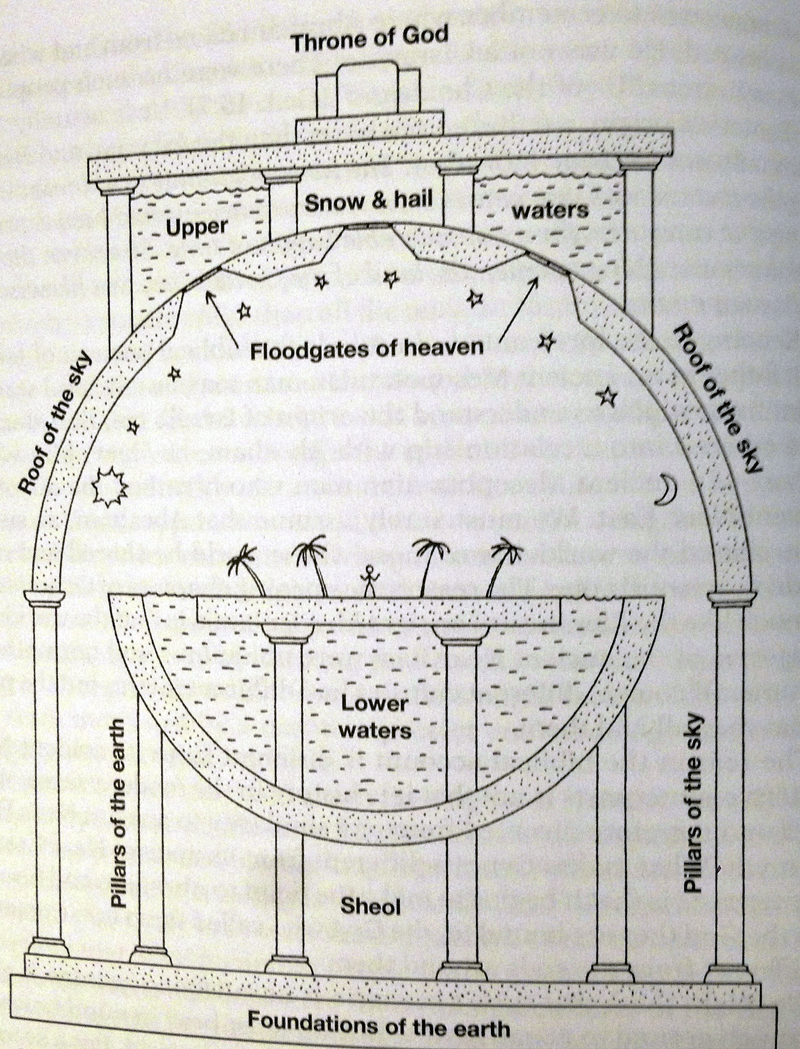
To your question that I may be excluding divine revelation in the text by denying the narrative's literal history: I think the logic here is a little funny. We have to receive books of the Bible for what they are: Psalms, Proverbs, Song of Songs, Job--these are books that have to be received certain ways, and cannot all be treated the same way. When you say I could be excluding divine intention by denying the creation accounts any literal history, you're assuming the creation narratives might have actually been written to record literal history. When you study whether or not this is the case, it becomes obvious that that was not the author's intention at all. I am not going to make a full case for this claim, but I'll provide a couple examples to make the point: The Genesis creation accounts use mythical images that pre-date Genesis by hundreds of years. Also, the ancient Near East, including the Jewish people, believed in a structure of the world that we know now not to be true. For example, the sun, to them, was the thing that moved, not the earth (see Josh. 10:12; Ps. 104:5; 19:6; Ecc. 1:5, to cite a few). The picture above is an illustration of how ancient Israelites viewed the cosmos (I took the picture with my iPhone, it comes from Peter Enns' book Inspiration and Incarnation, haha).
These examples show that Israelites did not have a perfect understanding of the universe and how it operated/came into being. And why would they? These are ancient people who had nowhere near the scientific data that we have today (and I'm not just referring to evolution; I'm also referring to the earth's rotation around the sun, the fact that the earth is a sphere, the fact that the earth is not made up of a big piece of land surrounded on all sides by water, and others). Why should we expect ancient Israelites to know things they would have no way of knowing? Because they received revelation from God? Why was it important for God to tell them how the universe actually operated? Such issues were not concerns for them.
Oh, I get it; it's because the Bible has God as its ultimate author, and if he wrote things about the universe, then they have to be true. Well, a lot of the Bible is not going to make a lot of sense until we divorce ourselves from this concept. Not only is the belief not necessary, but it is nowhere taught by Jesus, or anyone else in whose authority we put our faith. My problem with inerrantists is that they expect way too much from the Bible. They are not realistic about what the Bible actually is, and in an attempt to make Scripture something in which people can put their faith, they over-step and make it out to be something it was never intended to be. Once you look at all the evidence, it is, in my mind, impossible to go
return to the view that the creation accounts record actual history. If your view of Scripture doesn't allow for that possibility, I think you're expecting too much from the Bible, and not being very realistic about what it actually is.
There's my rant for today. Haha.
You asked, What is the purpose of attempting to show that the Genesis account is not completely unique? (I like your use of 'attempting'). The point of doing that was to set the stage for the purpose of my post, which was to show how Yahweh is unlike the gods of the ancient Near East. I wanted to show that the Genesis accounts are up to their neck in the ancient Near Eastern culture, so that I could point to the author's intent, which I think was to present the incomparability of Yahweh to an ancient Near Eastern people.
I wish you would have expanded on your claim that my open theist views were making their way into my interpretation of the text. You didn't give me an example. Maybe, if you had, I could have explained to you why the text leads me to make such a claim; or, maybe there was something with which I could admit that I was taking poetic license with the text (which is not impossible!).
I can see that, in a mythical reading of Genesis 2, it would seem odd to claim that the human participated in God's creation of the world. "Wait, doesn't he deny that this is actual history? What is he saying?" I think the narrative points to the reality that we were created to help bring creation forward. We were created to care for the earth, to procreate (which literally consists of humans participating in God's creative activity), and to reign over it. My point was that humans are the gardeners with God in the Garden of Eden, which symbolizes our duty to care for creation and help bring it forward. It also points to the power that God has given humanity. That the human in the creation narrative participates in the creative activity of God shows that God invited humanity to play a significant role in the production of human history.
When I said that God doesn't always get his way, I was pulling from Genesis 3. He gave them a command (which implies that they have the power to oppose his will, because his will is for them to follow his command) and in chapter 3, they break the command, opposing his will. Again, clearly this is a God that doesn't always get his way.
I find your comments on God's self-glorification...odd, to say the least. You're comparing God's self-glorification to selfies on Facebook? While I applaud you for realizing that the doctrine of God's self-glorification implies narcissism (or maybe your comment doesn't go that far), I find it funny that you don't see this as a problem. Do we really serve an ego-maniacal, self-obsessed God?
Also, your assessment of God creating humanity in his--or, better, their--image is presumptuous. The text does not imply self-glorification. God says, "let us make mankind in our image, in our likeness" (1:26). Christians can apply the Trinity to this statement, but even without the doctrine of the Trinity, a better (but not necessarily correct) interpretation would be that humans were created in the relational image of God, in which it is not good for us to be alone (2:18). But even if you don't like this interpretation, self-glorification is not in the text. God could be being narcissistic when he says "let's create humanity to be like us," but this is not at all necessary. If we do apply the doctrine of the Trinity to this scene (and why shouldn't we?), it would be much better to say that the Trinity wanted to create more participants in their relation of love. After all, God is love, so if God is to make humans in his image, love will be at the front of the list; and not love of self (if God is narcissistic, doesn't that imply that we should be the same way?), but other-focused love, Trinity love.
Finally, while I do think we should worship God, you impose on the narrative when you assert that there should be an emphasis on the human's call to worship God in an assessment of Genesis 2. Nowhere in this narrative is that call made.
Paul, this has been a lot fun. We should try to think of something else on which we can collaborate. Let's try a different format next time. Maybe a Q&A? Or maybe we put up a passage and post one blog with our initial responses to the passage, and then responses to each other. Let's brainstorm.
God Bless!
Showing posts with label ancient near east. Show all posts
Tuesday, July 23, 2013
Sunday, July 14, 2013
A Theology of Genesis 2: Yahweh in Relationship
There are many ancient Near Eastern creation narratives, with many similarities to those in the Hebrew Bible.(1) It is for this reason, among many others, that I have found it impossible to view the creation accounts in Genesis as literal history of how the world was actually brought into being.(2) Accepting this has caused me to view Genesis 1-3 much differently: If the purpose of these narratives was not to record actual history, what was the purpose? What were the authors of these narratives trying to say through them? I am not interested in answering these questions here. What I am most interested in is what these narratives say about God; and in this study, I have set out to address what Genesis 2, in particular, says about God.
Genesis 2 and the Ancient Near East
My main purpose here is to give life to the uniqueness of the God of Israel, showing what differentiates him from the gods of the other ancient Near Eastern creation stories. Before I do this, I should share with you some of the commonalities between Genesis 2 and other creation accounts. These are pulled from Peter Enns' book The Evolution of Adam:
I contend that Yahweh's uniqueness is found in his relationality with the people of Israel (I agree with Enns that Adam & Eve represent Israel in the story).
Yahweh, a God of Relationship
Terence Fretheim provides several characteristics of genuine divine-human relationship:(4)
Yahweh is genuinely affected by the relationship and is concerned about the creature's entire self
We begin this section with an astute observation by Bill Arnold:
The God depicted in Genesis 2 cares that ādām is alone and wants to provide someone for him (v.18) so that he can be a relational being as Yahweh is ("let us," 1:26).(8) Yahweh is deeply affected by his relationship with humans, and is concerned about their entire selves.
Yahweh is not the only one with something to say; nor is he the only one with something to do and the power to do it
Fretheim says, "Twice, God 'brings' a creature [to the man] . . . [and] lets the human being determine whether [they] . . . are adequate to move the evaluation from 'not good' to 'good.'"(9) Indeed, in verse 23, it is ādām that determines that the creation is good. This reveals that Yahweh wants to receive input from his creatures. He wants their involvement in his creation. In the God-human relationship, Yahweh is not the only being with something to say.
That Yahweh made it so that he was not the only one with something to do and the power to do it can be seen in the incredible responsibility he gives ādām to name all the animals. This might not seem significant to us, but, as Gerhard von Rad provides , "name-giving in the ancient Orient was primarily an exercise of sovereignty."(10) "Without any qualification in the text," Fretheim observes, "whatever the human being called each animal, that was its name (2:19). Whatever!"(11)
Furthermore, Arnold states that by "pronouncing the name of each [animal] as they were created, the human participated in the creative process with God."(12) As Fretheim says, in Genesis 2, "Divine decisions interact with human decisions in the creation of the world."(13) Andre Jolles powerfully conveys the significance of this name-giving:
To step out of our present chapter for a second and go to the first creation narrative, we find a fascinating verse, in which Elohim says to the humans: "Be fruitful and multiply and fill the earth and conquer it, and hold sway over the fish of the sea and the fowl of the heavens and every beast that crawls upon the earth" (1:28). The Hebrew words for 'conquer' and 'hold sway' denote sovereignty, "an absolute or even fierce exercise of mastery."(17) Consider the powerful claims of Ps. 8:5-8:
The human will can stand against the will of Yahweh
This is evident in the "vocation, permission, and prohibition" that Yahweh gives the humans:(18) "From every fruit of the garden you may surely eat. But from the tree of knowledge, good and evil, you shall not eat, for on that day you eat from it, you are doomed to die" (vv.16b-17) The humans can eat all they want from any tree of the garden, but they are forbidden to eat from the tree of the knowledge of good and evil. Furthermore, the humans were created to till and watch over the earth (v.15), to rule over it (1:28). Walter Brueggemann has observed that, today, the "divine will for vocation and freedom has been lost. The God of the garden is chiefly remembered as the one who prohibits. But the prohibition makes sense only in terms of the other two."(19) Yahweh gave the humans power and freedom, but also a warning of what happens when that power is abused. This warning would be nonsensical if the human will could not stand against Yahweh's will. Here is a God who does not always get his way.
Yahweh shares power, gives freedom, risks his will, and submits to the possibility of opposition. The human will can stand against his.
In the Yahweh-Israel relationship, the future is not all mapped out in advance
"The two trees," Fretheim says, "represent two possible futures: life and death."(20) This motif of two possible futures is found throughout the Hebrew Bible. Here is an example:
"O Lord, Who is Like You?"
In Genesis 2, God is not a fully transcendent, self-glorifying figure. His first act as Creator is not to demand worship from the creatures; rather, he focuses on them the whole time! He selflessly gives the human freedom, adheres to the human's needs, receives input from the human, and gives the human power. Genesis 2 reveals that Yahweh, unlike the gods of the ancient Near Eastern creation stories, is concerned with being intimately involved with his people, and sharing with them a genuine relationship, the sustaining of which depends on all of these qualities.(22)
[Read Paul Imbrone's response to this here]
Notes:
(1) For similarities between ancient Near Eastern texts and the Hebrew Bible, see Kenton Sparks, Ancient Texts for the Study of the Hebrew Bible (Peabody: Hendrickson, 2005); John Walton, Ancient Near Eastern Thought and the Old Testament (Grand Rapids: Baker Academic, 2006); Walton, Ancient Israelite Literature in its Cultural Context (Grand Rapids: Zondervan, 1994); and J.J.M. Roberts, The Bible and the Ancient Near East: Collected Essays (Eisenbrauns, 2002).
(2) For other reasons, see Peter Enns, The Evolution of Adam (Grand Rapids: Brazos Press, 2012).
(3) Ibid., 55.
(4) These come from a presentation Terence Fretheim gave called "Divine-Human Relationship." This can be found on Itunes U. All but one of the listed characteristics can also be found in his book, God and World in the Old Testament: A Relational Theology of Creation (Nashville: Abingdon Press, 2005), 21-22.
(5) Bill T. Arnold, Genesis (Cambridge: Cambridge University Press, 2009), 56.
(6) Fretheim, "Genesis," in The New Interpreter's Bible: Volume 1, ed. Leander E. Keck: 319-674 (Nashville: Abingdon Press, 1994), 349.
(7) Arnold, 58.
(8) See Fretheim, God and World, 56.
(9) Fretheim, "Genesis," 352.
(10) Gerhard von Rad, Genesis: A Commentary (Louisville: Westminster John Knox Press, 1973), 81.
(11) Fretheim, God and World, 58.
(12) Arnold, 60.
(13) Fretheim, God and World, 58.
(14) Andre Jolles, quoted in von Rad, 80-81.
(15) Phyllis Trible, quoted in Fretheim, "Genesis," 352.
(16) Ibid., 356.
(17) Robert Alter, Genesis: Translation and Commentary (New York: W.W Norton & Co., 1996), 5.
(18) See Walter Brueggemann, Genesis (Lousiville: Westminster John Knox Press, 1982), 46.
(19) Ibid.
(20) Fretheim, "Genesis," 352.
(21) Ibid., 357.
(22) Walton also recognizes this unique quality. See his Ancient Near Eastern Thought and the Old Testament, 110.
Genesis 2 and the Ancient Near East
My main purpose here is to give life to the uniqueness of the God of Israel, showing what differentiates him from the gods of the other ancient Near Eastern creation stories. Before I do this, I should share with you some of the commonalities between Genesis 2 and other creation accounts. These are pulled from Peter Enns' book The Evolution of Adam:
- "A garden/paradise of God/the gods in the east (Enki and Ninhursag; Gilgamesh)
- Humans created out of dust/clay to cultivate the land (Enki and Ninmah [Sumerian]; Atrahasis; Gilgamesh)
- Humans infused with the Breath of Life (Instructions of Merikare [Egyptian]) . . .
- Streams of water supply irrigation to the garden (Enki and Ninhursag) . . .
- The female made from the male's rib/side (Enki and Ninhursag [referring to a goddess])"(3)
I contend that Yahweh's uniqueness is found in his relationality with the people of Israel (I agree with Enns that Adam & Eve represent Israel in the story).
Yahweh, a God of Relationship
Terence Fretheim provides several characteristics of genuine divine-human relationship:(4)
- The Yahweh-Israel relationship is such that Yahweh is not the only one with something to say
- It is also a relationship in which Yahweh is not the only one with something to do and the power to do it
- Yahweh is genuinely affected by the relationship
- Yahweh is concerned about the human's entire self
- In this relationship, the human will can stand against the will of Yahweh
- The Yahweh-Israel relationship is one in which the future is not all mapped out
Yahweh is genuinely affected by the relationship and is concerned about the creature's entire self
We begin this section with an astute observation by Bill Arnold:
Gen. 1 portrays the transcendent and sovereign Creator commanding order from chaos by a series of cuts and separations, structuring the world and its inhabitants according to types and categories. Now, 2:4–25 complements that portrait with one in which the immanent and intensely personal Yahweh Elohim, LORD God, shapes humanity from clay like a potter (2:7).(5)The image of God as potter, says Fretheim, "reveals a God who focuses closely on the object to be created and takes painstaking care to shape each one into something useful and beautiful."(6) Indeed, the human is "fearfully and wonderfully made" (Ps. 139:14): Yahweh pays acute attention to detail in creating humanity, cautiously engaging in the art of perfecting his craft. This is a God who genuinely cares about humans, unlike the gods of the ancient Near East, to whom the creation of humanity was either an afterthought or an act of selfish gain.(7)
The God depicted in Genesis 2 cares that ādām is alone and wants to provide someone for him (v.18) so that he can be a relational being as Yahweh is ("let us," 1:26).(8) Yahweh is deeply affected by his relationship with humans, and is concerned about their entire selves.
Yahweh is not the only one with something to say; nor is he the only one with something to do and the power to do it
Fretheim says, "Twice, God 'brings' a creature [to the man] . . . [and] lets the human being determine whether [they] . . . are adequate to move the evaluation from 'not good' to 'good.'"(9) Indeed, in verse 23, it is ādām that determines that the creation is good. This reveals that Yahweh wants to receive input from his creatures. He wants their involvement in his creation. In the God-human relationship, Yahweh is not the only being with something to say.
That Yahweh made it so that he was not the only one with something to do and the power to do it can be seen in the incredible responsibility he gives ādām to name all the animals. This might not seem significant to us, but, as Gerhard von Rad provides , "name-giving in the ancient Orient was primarily an exercise of sovereignty."(10) "Without any qualification in the text," Fretheim observes, "whatever the human being called each animal, that was its name (2:19). Whatever!"(11)Furthermore, Arnold states that by "pronouncing the name of each [animal] as they were created, the human participated in the creative process with God."(12) As Fretheim says, in Genesis 2, "Divine decisions interact with human decisions in the creation of the world."(13) Andre Jolles powerfully conveys the significance of this name-giving:
Man attacks the confusion of the world; by probing, restricting and combining he brings together what belongs together. That which lies piled up in the confusion of the world does not at the start possess its own form; but rather, what is here distinguished with discrimination receives its own form only as it comes together in the analysis.(14This paints Yahweh as a God who shares power with his creatures. He genuinely cares about what the humans want to do and gives them the power to do it. As Phyllis Trible states, God here is not portrayed as "the authoritarian controller of events but as the generous delegator of power who even forfeits the right to reverse human decisions."(15) Fretheim echoes this, saying "the divine sovereignty in creation is understood, not in terms of absolute divine control, but as a sovereignty that gives power over to the created for the sake of a relationship of integrity."(16)
To step out of our present chapter for a second and go to the first creation narrative, we find a fascinating verse, in which Elohim says to the humans: "Be fruitful and multiply and fill the earth and conquer it, and hold sway over the fish of the sea and the fowl of the heavens and every beast that crawls upon the earth" (1:28). The Hebrew words for 'conquer' and 'hold sway' denote sovereignty, "an absolute or even fierce exercise of mastery."(17) Consider the powerful claims of Ps. 8:5-8:
...you have made [human beings] a little lower than God,Clearly, Yahweh's purpose was not to be the only being with something to do and the power with which to do it.
and crowned them with glory and honor.
You have given them dominion over the works of your hands;
you have put all things under their feet,
all sheep and oxen,
and also the beasts of the field,
the birds of the air, and the fish of the sea,
whatever passes along the paths of the seas.
The human will can stand against the will of Yahweh
This is evident in the "vocation, permission, and prohibition" that Yahweh gives the humans:(18) "From every fruit of the garden you may surely eat. But from the tree of knowledge, good and evil, you shall not eat, for on that day you eat from it, you are doomed to die" (vv.16b-17) The humans can eat all they want from any tree of the garden, but they are forbidden to eat from the tree of the knowledge of good and evil. Furthermore, the humans were created to till and watch over the earth (v.15), to rule over it (1:28). Walter Brueggemann has observed that, today, the "divine will for vocation and freedom has been lost. The God of the garden is chiefly remembered as the one who prohibits. But the prohibition makes sense only in terms of the other two."(19) Yahweh gave the humans power and freedom, but also a warning of what happens when that power is abused. This warning would be nonsensical if the human will could not stand against Yahweh's will. Here is a God who does not always get his way.
Yahweh shares power, gives freedom, risks his will, and submits to the possibility of opposition. The human will can stand against his.
In the Yahweh-Israel relationship, the future is not all mapped out in advance
"The two trees," Fretheim says, "represent two possible futures: life and death."(20) This motif of two possible futures is found throughout the Hebrew Bible. Here is an example:
This is what the Lord says: Do what is just and right. Rescue from the hand of the oppressor the one who has been robbed. Do no wrong or violence to the foreigner, the fatherless or the widow, and do not shed innocent blood in this place. For if you are careful to carry out these commands, then kings who sit on David’s throne will come through the gates of this palace, riding in chariots and on horses, accompanied by their officials and their people. But if you do not obey these commands, declares the Lord, I swear by myself that this palace will become a ruin.What humanity's future will look like is up to their decisions: "All depends on what the humans do with what God presents."(21) Yahweh as revealed in Genesis 2 does not have a blueprint of his will for human history; he leaves human history is up to humans. The image of divine potter in Jeremiah 18 shows a God who adapts to the decisions of his people, not a God who decides their future himself. Is it a coincidence that the potter image can be found in the narrative of creation, the beginning of human history (2:7)?
Jeremiah 22:3-5
"O Lord, Who is Like You?"
In Genesis 2, God is not a fully transcendent, self-glorifying figure. His first act as Creator is not to demand worship from the creatures; rather, he focuses on them the whole time! He selflessly gives the human freedom, adheres to the human's needs, receives input from the human, and gives the human power. Genesis 2 reveals that Yahweh, unlike the gods of the ancient Near Eastern creation stories, is concerned with being intimately involved with his people, and sharing with them a genuine relationship, the sustaining of which depends on all of these qualities.(22)
[Read Paul Imbrone's response to this here]
Notes:
(1) For similarities between ancient Near Eastern texts and the Hebrew Bible, see Kenton Sparks, Ancient Texts for the Study of the Hebrew Bible (Peabody: Hendrickson, 2005); John Walton, Ancient Near Eastern Thought and the Old Testament (Grand Rapids: Baker Academic, 2006); Walton, Ancient Israelite Literature in its Cultural Context (Grand Rapids: Zondervan, 1994); and J.J.M. Roberts, The Bible and the Ancient Near East: Collected Essays (Eisenbrauns, 2002).
(2) For other reasons, see Peter Enns, The Evolution of Adam (Grand Rapids: Brazos Press, 2012).
(3) Ibid., 55.
(4) These come from a presentation Terence Fretheim gave called "Divine-Human Relationship." This can be found on Itunes U. All but one of the listed characteristics can also be found in his book, God and World in the Old Testament: A Relational Theology of Creation (Nashville: Abingdon Press, 2005), 21-22.
(5) Bill T. Arnold, Genesis (Cambridge: Cambridge University Press, 2009), 56.
(6) Fretheim, "Genesis," in The New Interpreter's Bible: Volume 1, ed. Leander E. Keck: 319-674 (Nashville: Abingdon Press, 1994), 349.
(7) Arnold, 58.
(8) See Fretheim, God and World, 56.
(9) Fretheim, "Genesis," 352.
(10) Gerhard von Rad, Genesis: A Commentary (Louisville: Westminster John Knox Press, 1973), 81.
(11) Fretheim, God and World, 58.
(12) Arnold, 60.
(13) Fretheim, God and World, 58.
(14) Andre Jolles, quoted in von Rad, 80-81.
(15) Phyllis Trible, quoted in Fretheim, "Genesis," 352.
(16) Ibid., 356.
(17) Robert Alter, Genesis: Translation and Commentary (New York: W.W Norton & Co., 1996), 5.
(18) See Walter Brueggemann, Genesis (Lousiville: Westminster John Knox Press, 1982), 46.
(19) Ibid.
(20) Fretheim, "Genesis," 352.
(21) Ibid., 357.
(22) Walton also recognizes this unique quality. See his Ancient Near Eastern Thought and the Old Testament, 110.
Subscribe to:
Posts (Atom)

