The Blog of Jack Holloway
Showing posts with label authority of Scripture. Show all posts

Sunday, April 27, 2014

3 Things You Need to Know About Divine Violence in the Bible

For the past 8 months now I have been reading every book I can get about divine violence in the Bible. So far, I've read about 20, and I have 5 more to go. In my reading I have been noticing a trend that I think is important to acknowledge when framing one's discussion of this topic. I think the issue centers around 3 vital components, which often go unnoticed in debates (see, for example, my review of 4 Views on God and Canaanite Genocide, here).

1. This is first and foremost an issue of the authority of Scripture

Is all of Scripture God's self revelation? Does every portrait of God painted in Scripture perfectly depict his true nature? Does Jesus repudiate any Old Testament theologies? Did the Israelites get anything wrong about God? These questions need to be dealt with first. How you answer them will determine what the rest of your approach is going to look like.

If Scripture is infallible, then that means none of Scripture's depictions of God are flawed. If you believe Scripture has God as its ultimate author, that every part of Scripture was willed and determined by God, then that means all of Scripture's theology is really God's self-description, and none of it is wrong. What is your view of Scripture? That will be the biggest deciding factor in your understanding of the issue of divine violence in the Bible. As Thom Stark has said, "In the end, the way one looks at these things and the manner in which one interprets these matters depends completely on one's theology of sacred scripture" (The Human Faces of God, 2011, p.150).

Too often biblical scholars have neglected this issue in their discussions of Scripture's violent portrayals of God. None of the contributors to 4 Views on God & Canaanite Genocide, for example, discussed this aspect of the problem in their respective chapters.

2. This is an issue of the historicity of certain biblical books

Related to the authority of Scripture aspect of this problem is the issue of whether or not the OT books are historically accurate. Did God flood the entire earth, killing most of its inhabitants? Did God toss the Egyptian warriors into the Red Sea? Did God deliver Jericho into the hands of the Israelites so that when they marched around the city and shouted its walls miraculously came crumbling down? Did God hand the Canaanites over to the Israelites so that they could defeat them in battle? How reliable is the OT history? If it is indeed historically reliable, and the battles happened exactly the way the texts say they happened, then it seems that we would have to say that God actually did do those things.

Furthermore, when the OT says, "Thus says the Lord," does it reflect what God actually said? Are such speeches of God historical? If so, we would have to admit that God did command Saul through Samuel, "Go, attack the Amalekites and totally destroy all that belongs to them. Do not spare them; put to death men and women, children and infants, cattle and sheep, camels and donkeys" (1 Sam. 15:3).

Are all the battle stories in the OT accounts of actual historical events? How you answer this question will be a significant determining factor in your understanding of the larger issue.

3. This is an issue of how to interpret the book of Revelation

Often in their arguments for the continuity between the theology of the OT and that of Jesus, Evangelical scholars will refer to the book of Revelation, which seems to portray Jesus in the same violent manner in which God is portrayed in the OT.

I think this one is so important because if we were to base our understanding of the God revealed in Jesus solely on his teachings and example described in the Gospels, I think most Christians would recognize a discontinuity between the theology of Jesus and that of certain parts of the OT.

For example, when his disciples suggest that they pray for God to strike fire on the Samaritans for refusing to let them into their village, Jesus rebukes them and says, "You know not what spirit you are of, for the Son of Man has not come to destroy the lives of human beings but to save them" (Luke 9:55). Also, Jesus repudiates the OT teaching of "an eye for an eye and a tooth for a tooth" (Deut 19:21; Ex 21:24; Lev 24:20) and taught that we shouldn't be violent but should rather engage people peacefully (Matt 5:38-39). Rejecting the way the Israelites dehumanized and hated their enemies (for example, Ps 139:21), Jesus taught that we should love our enemies and pray for them (Matt 5:43-44). Indeed, I think the dominant Christian consensus would be that Jesus rejected the violent theologies of the OT, if it were not for passages in the book of Revelation like this one:
I saw heaven standing open and there before me was a white horse, whose rider is called Faithful and True. With justice he judges and wages war. . . . He is dressed in a robe dipped in blood, and his name is the Word of God. The armies of heaven were following him, riding on white horses and dressed in fine linen, white and clean. Coming out of his mouth is a sharp sword with which to strike down the nations. "He will rule them with an iron scepter." He treads the winepress of the fury of the wrath of God Almighty. . . . Then I saw the beast and the kings of the earth and their armies gathered together to wage war against the rider on the horse and his army. But the beast was captured, and with it the false prophet who had performed the signs on its behalf. . . . The two of them were thrown alive into the fiery lake of burning sulfur. The rest were killed with the sword coming out of the mouth of the rider on the horse, and all the birds gorged themselves on their flesh. 
Revelation 19:11-21
How do we interpret this passage? Do we take it at face value and interpret it to mean that Jesus is the same as the warrior God in the OT? How you interpret passages in Revelation like this will determine whether or not you think Jesus affirmed the violent theologies of the OT.

Recommended reading:
On the authority of Scripture with regard to divine violence, see Kenton Sparks, Sacred Word, Broken Word (Grand Rapids: Wm. B. Eerdmans, 2012). See my review, here. Also see Wesley Morrison, "Did God Command Genocide?: A Challenge to the Biblical Inerrantist," Philosophia Christi, 11, no. 1 (2009). Finally, see my blog, "God-Breathed: The Authority of Scripture According to the Greek Word θεόπνευστος," http://jdhollowayiii.blogspot.com/2013/11/god-breathed-authority-of-scripture.html

On the historicity of the Old Testament, see K. Lawson Younger, Jr., Ancient Conquest Accounts: A Study in Ancient Near Eastern and Biblical History Writing (Sheffield: Journal for the Study of the Old Testament, 1990). Also see Victor R. Matthews, A Brief History of Ancient Israel (Lousville: Westminster John Knox Press, 2002).

For a fantastic bibliography on the book of Revelation, see Greg Boyd, "Revelation and the Violent 'Pride-Fighting' Jesus," Reknew.org, http://reknew.org/2010/09/revelation-and-the-violent-prize-fighting-jesus/

Monday, April 14, 2014

Book Review: "Show Them No Mercy: 4 Views on God & Canaanite Genocide"

Show Them No Mercy: Four Views on God and Canaanite Genocide. Edited by Stanley Gundry. Grand Rapids: Zondervan, 2003. pp.7-218. ISBN 978-0-310-24568-1. ★★★☆☆

Stanley Gundry's Counterpoints in Bible & Theology series offers a lot of helpful introductions to various biblical and theological issues. Usually, the Counterpoints books are well-rounded and consist of multiple viewpoints. Given the series' reputation for providing several different viewpoints, I was disappointed and a little confused by this collection of arguments, which would be more properly titled "Two Views on God and Canaanite Genocide." There doesn't seem to be much of a difference between the approaches of Eugene Merrill, Daniel Gard, and Tremper Longman. All three are conservative scholars and, despite the curious [misleading] titles of their views (moderate discontinuity, eschatalogical continuity, and spiritual continuity), they all basically have the same understanding of how to interpret the violent material in the Bible; that is, all three affirm the infallibility (and probably also the inerrancy) of Scripture, that God did exactly as the text suggests, and that all of the violent actions attributed to him are moral and just. So then, the book consists of one liberal view (that of C.S. Cowles) against three equally conservative views. This is very odd, since there are clearly many more approaches than just these two. Roger Olson highlights nine in his article "Every Known Theistic Approach to Old Testament 'Texts of Terror'" (although, I think his use of 'every' is an overstatement).(1) One wonders if this set-up was purposeful, that Gundry wanted three conservative views against one liberal view to discourage readers from adopting the liberal view.

Since three of the views in this book are so similar, the conservative scholars' responses to each other consist of an unnecessary overview of the argument they're responding to, a pat on the back, and a struggle to find things with which to disagree. For example, in Gard's response to Merrill, one of his few critiques is that Merrill takes the 1000 years referred to Revelation literally, a point of difference which has nothing to do with God and Canaanite genocide. For this reason, one could just read Cowles' responses to the conservative approaches and skip the others.

What is also unfortunate about this book is that I doubt it will help much in the divide between Christians on this issue. The reason I say this is because the most crucial aspects of this issue were not given ample focus. I think the problem of divine violence in the Bible centers around two things: the authority of Scripture and how to interpret Revelation. Obviously, there are more factors at play, but I do think these two carry the most weight.

Most Christians will say that the Bible's violent depictions of God are at least troubling. The problem is, most Christians regard all of Scripture as infallible and as God's self-revelation. So when the Bible says God did something, there is no question, he definitely did it. Thus, it is first and foremast an issue of the authority of Scripture and how we are to read/interpret Scripture. The fact that all three conservative scholars mentioned the authority of Scripture in response to Cowles supports this understanding.

Also at the center of this issue is how we interpret Revelation. A central argument for those like Cowles who say that the violent depictions of God in the Old Testament do not reflect what he actually did or his actual nature, is that Jesus in his life and teaching presents a very different portrait of God, one who loves enemies, rejects using violence and reprimands those who use violence. At the end of the day, the only major element that complicates this understanding of Jesus is the book of Revelation, which seems to depict Jesus as the same kind of violent warrior that Yahweh is depicted as in the OT. This argument is used by all three conservative scholars in their responses to Cowles.

One can only really discuss divine violence in the Bible if one deals with how to interpret the disturbing parts of the Bible while maintaining its divine inspiration, and also by explaining how the depictions of Jesus in Revelation don't imply that he is a violent warrior. While I agreed wholeheartedly with most of what Cowles had to say, he unfortunately did not dedicate much time to addressing these core issues. He didn't discuss the authority of Scripture at all, and he limited his discussion of Revelation to a single quote from a scholar of Revelation in a footnote not even in his main contribution but in one of his responses to the others. Quite inadequate.

Overall, while I have highlighted the deficiencies of this collection of arguments, the book isn't altogether inadequate. It can still serve as a good introduction to the war material in the Bible and how we Christians should respond to it. That being said, I don't think it properly served its purpose, and I hope that a more comprehensive book that similarly focuses on the dialogue of opposing views will be put together in the future. If it does, hopefully it will represent more than two views, and hopefully it will include a much-needed discussion of the authority of Scripture and of the book of Revelation.

Notes:
(1) Roger Olson,  "Every Known Theistic Approach to Old Testament 'Texts of Terror," Patheos blog, http://www.patheos.com/blogs/rogereolson/2013/07/every-known-theistic-approach-to-old-testament-texts-of-terror/

Tuesday, November 26, 2013

God-Breathed: The Authority of Scripture According to the Greek Word θεόπνευστος

Understanding the Greek word θεόπνευστος (theopneustos) in II Timothy 3:16 is essential in discussing the doctrine of Scripture's authority. Unfortunately, there is ambiguity in uncovering what the word was meant to convey, and no absolutely solid conclusions can be made about it, regardless of what many claim. This study attempts to get at the boundaries of the word's meaning. What is necessarily implied by θεόπνευστος? And how much room for theological speculation is there? Finally, this study will attempt to show that the most reasonable interpretation of the word does not imply strict divine authorship, but rather, it only necessarily implies divine sanction of the text, so that the Bible can be the product of humans, while still imbued with the Spirit of God as the vessel of his message to the world.

Etymologically, it seems to be universally agreed that θεόπνευστος means 'God-breathed'.(1) This is often taken to mean "breathed into by God" and, so, "inspired by God,"(2) but others translate it "breathed out by God" (ESV), suggesting that 'God-breathed' means it was spoken from the mouth of God, that "it originate[d] in God."(3)

In context, the word is used to assure Timothy of the value and power of Scripture. Timothy was to prepare himself to face challenges, persecution, and to be ready to do the good work of God, and he needed to be equipped with the sacred writings from which he had learned. William Mounce concludes that, given the context, we should interpret II Tim. 3:16 to mean that the "utility of Scripture flows out of its inspiration. The entirety of Scripture comes from the mouth of God. . . . It is therefore true, and it can therefore be trusted."(4) However, Mounce overstates what the context implies. Paul could just as well affirm Scripture's utility and trustworthiness by merely saying that it is imbued with the Holy Spirit; that it ultimately has God as its author is not explicitly implied by the verse. So, unfortunately, the context in this case does not make the interpretation process easier.

While θεόπνευστος is not used anywhere else in Scripture, many often turn to II Peter 1:20-21 to help interpret its meaning, as it seems to convey the same idea about Scripture, saying that "no prophecy of Scripture comes from someone’s own interpretation," nor are they "ever produced by the will of man," but they come "from God" and are "carried along by the Holy Spirit." This seems to be clearer than the meaning of the word θεόπνευστος; however, ambiguity lies here also. The Greek word φέρω ("carried along") conveys the image of the wind and the sea carrying along a ship.(5) The verse does not have to mean that the Scriptures came directly from the mouth of God; it could just mean that those who delivered the prophecies of Scripture were propped up and influenced by the Holy Spirit, and that their words have divine power. As Richard Bauckham states, II Peter 1:20-21 does not advocate
a basically pagan understanding of the psychology of prophetic inspiration, as irrational ecstasy in which the prophet is a purely passive instrument of the divine Spirit. . . . [T]he language of 2 Peter does not in itself require such a depreciation of the human role in prophecy.(6)
There are too many nuances in these passages that simply make it too hard to claim a concrete stance on the authority of Scripture. But what boundaries does θεόπνευστος put on the doctrine? For lack of better wording, what is the least one could say about Scripture's authority and still affirm its nature as God-breathed? Well, for one, Kenton Sparks notes that "the Greek word itself does not really imply anything in particular about how the transaction between God and the human authors took place."(7) Similarly, Colin Brown states that it "does not imply any particular mode of inspiration, such as some form of divine dictation."(8) He concludes that it should be interpreted to mean that the "sacred scriptures are all expressive of the mind of God."(9) However, what exactly it expresses about the mind of God is not clear. Does it express his word choice and his knowledge? Or could it express his desire to partner with humanity?

A particularly enlightening take on this verse is found in an article by Edward Goodrick:
I suspect that to one schooled as well as Timothy was in the OT the new word, theopneustos, would have triggered his recollection of that primeval episode in which God, by breathing into the nostrils of an image molded from inert clay, made it spring into life. Certainly Adam was God-breathed.(10)
So, at the very least, Scripture is just as God-breathed as Adam was, as humans are. Furthermore, that Adam was God-breathed did not mean that he was controlled by God, that every choice he made was God's choice, every word he spoke was God's word. Rather, God sustains humans and tries to influence us with his nature so that we will participate in his love. He also tries to use us to accomplish his will in the world. Likewise, God inspired the biblical authors, the Spirit supported and influenced their work, and God uses it to communicate and accomplish his will to the world. In Sparks' words, "Scripture is God's word because God providentially adopted ancient human beings . . . as his spokespersons. In doing so God 'set apart' or 'sanctified' their words for use in his redemptive activity."(11)

With the image of a ship supported and influenced by the wind and the sea, and with the help of having Adam as another example of something God-breathed, we can at least affirm with confidence that πᾶσα γραφὴ θεόπνευστος (every Scripture is God-breathed) in that it has divine power and is imbued with the Holy Spirit to be used by God to accomplish his will. Stephen Chapman said that biblical inspiration is "a cipher for a mysterious process of divine-human co-writing."(12) Though there are many elements of Scripture that are thoroughly human, Paul has taught us that God would not have it any other way.(13) What a beautiful statement to be able to make about God, that he adopted as the vessel of the divine message of Jesus Christ a book the writing of which was accomplished by God's participation in the creativity of humans. What a beautiful picture that paints of the relationship between God and humanity, that it is one of partnership and freedom, in which God wants the other to have a voice and autonomous creativity.(14) He is not simply interested in what he can do; he is interested in what we can do, and what we can do together.

Notes:
(1) Colin Brown, "graphē," in Vol. 3 of The New International Dictionary of New Testament Theology (Grand Rapids: Zondervan, 1978), 491.
(2) John Henry Thayer, Greek-English Lexicon of the New Testament, rev. ed. (New York: Harper & Brothers, 1889), 287. The NLT, NASB, HCSB, NET, and others use this translation.
(3) H. Wayne House, "Biblical Inspiration in 2 Timothy 3:16," Bibliotheca sacra 137 (1980), 61.
(4) William D. Mounce, Pastoral Epistles, Vol. 46 of WBC, Accordance/Thomas Nelson electronic ed. (Waco: Word Books, 2000), 570.
(5) "φέρω," in Mounce Concise English-Greek Dictionary of the New Testament, eds. William D. Mounce, with Rick D. Bennett, Jr., Accordance/Thomas Nelson electronic ed.
(6) Richard J. Bauckham, Jude, 2 Peter, Vol. 50 of Word Biblical Commentary, Accordance/Thomas Nelson electronic ed. (Waco: Word Books, 1983), 234.
(7) Kenton L. Sparks, Sacred Word, Broken Word: Biblical Authority & the Dark Side of Scripture (Grand Rapids: William B. Eerdmans, 2012), 56.
(8) Brown, 491.
(9) Ibid.
(10) Edward W. Goodrick, "Let's Put 2 Timothy 3:16 Back in the Bible," Journal of the Evangelical Theological Society 25, no.4 (1982), 484.
(11) Sparks, 29.
(12) Sparks, 58.
(13) For more on the inspiration of Scripture despite its utter humanness, see Sparks, Sacred Word, Broken Word, and Peter Enns, Inspiration and Incarnation (Grand Rapids: BakerAcademic, 2005).
(14) For more on the relational partnership of God and humanity, see Terence E. Fretheim, God and the World in the Old Testament: A Relational Theology of Creation (Nashville: Abingdon Press, 2005).

Tuesday, July 23, 2013

A Response to Paul Imbrone's Assessment of My Blog on Genesis 2

[Read Paul's response to John Daniel's blog here]

Paul,

I think my assessment does apply to authorial intent, because I think the author of the narrative's intent was to take ancient Near Eastern myths and use them to point to Yahweh, the incomparable one true LORD God.

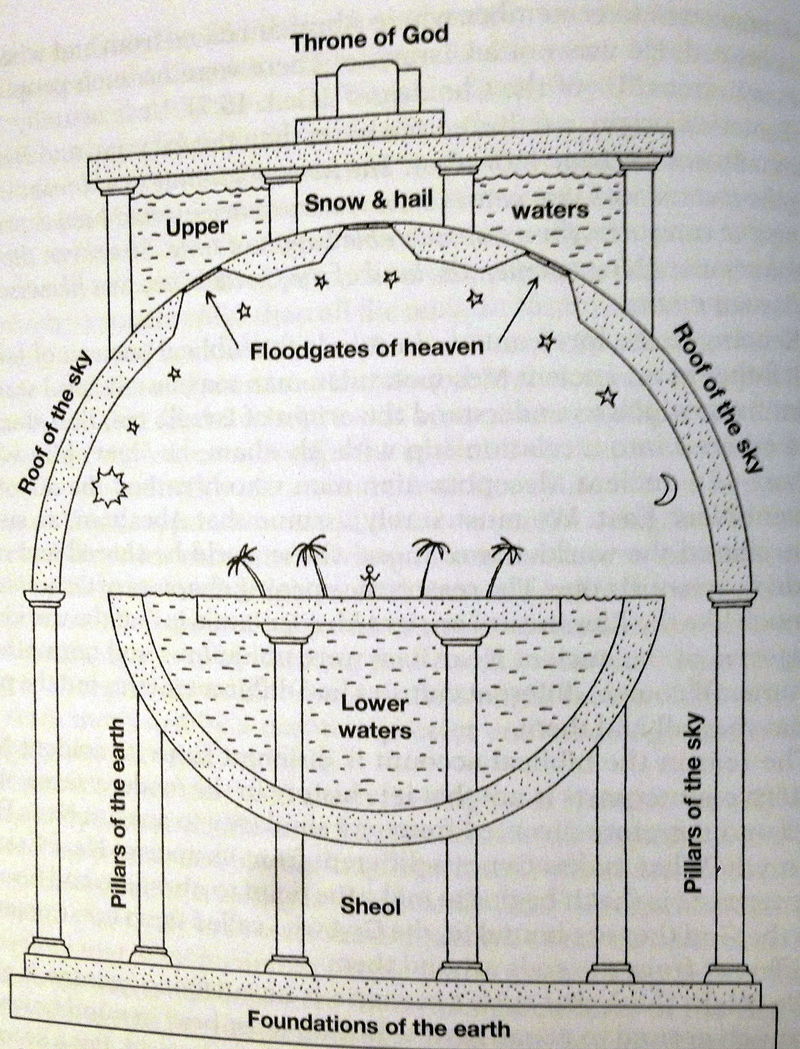
To your question that I may be excluding divine revelation in the text by denying the narrative's literal history: I think the logic here is a little funny. We have to receive books of the Bible for what they are: Psalms, Proverbs, Song of Songs, Job--these are books that have to be received certain ways, and cannot all be treated the same way. When you say I could be excluding divine intention by denying the creation accounts any literal history, you're assuming the creation narratives might have actually been written to record literal history. When you study whether or not this is the case, it becomes obvious that that was not the author's intention at all. I am not going to make a full case for this claim, but I'll provide a couple examples to make the point: The Genesis creation accounts use mythical images that pre-date Genesis by hundreds of years. Also, the ancient Near East, including the Jewish people, believed in a structure of the world that we know now not to be true. For example, the sun, to them, was the thing that moved, not the earth (see Josh. 10:12; Ps. 104:5; 19:6; Ecc. 1:5, to cite a few). The picture above is an illustration of how ancient Israelites viewed the cosmos (I took the picture with my iPhone, it comes from Peter Enns' book Inspiration and Incarnation, haha).

These examples show that Israelites did not have a perfect understanding of the universe and how it operated/came into being. And why would they? These are ancient people who had nowhere near the scientific data that we have today (and I'm not just referring to evolution; I'm also referring to the earth's rotation around the sun, the fact that the earth is a sphere, the fact that the earth is not made up of a big piece of land surrounded on all sides by water, and others). Why should we expect ancient Israelites to know things they would have no way of knowing? Because they received revelation from God? Why was it important for God to tell them how the universe actually operated? Such issues were not concerns for them.

Oh, I get it; it's because the Bible has God as its ultimate author, and if he wrote things about the universe, then they have to be true. Well, a lot of the Bible is not going to make a lot of sense until we divorce ourselves from this concept. Not only is the belief not necessary, but it is nowhere taught by Jesus, or anyone else in whose authority we put our faith. My problem with inerrantists is that they expect way too much from the Bible. They are not realistic about what the Bible actually is, and in an attempt to make Scripture something in which people can put their faith, they over-step and make it out to be something it was never intended to be. Once you look at all the evidence, it is, in my mind, impossible to go return to the view that the creation accounts record actual history. If your view of Scripture doesn't allow for that possibility, I think you're expecting too much from the Bible, and not being very realistic about what it actually is.

There's my rant for today. Haha.

You asked, What is the purpose of attempting to show that the Genesis account is not completely unique? (I like your use of 'attempting'). The point of doing that was to set the stage for the purpose of my post, which was to show how Yahweh is unlike the gods of the ancient Near East. I wanted to show that the Genesis accounts are up to their neck in the ancient Near Eastern culture, so that I could point to the author's intent, which I think was to present the incomparability of Yahweh to an ancient Near Eastern people.

I wish you would have expanded on your claim that my open theist views were making their way into my interpretation of the text. You didn't give me an example. Maybe, if you had, I could have explained to you why the text leads me to make such a claim; or, maybe there was something with which I could admit that I was taking poetic license with the text (which is not impossible!).

I can see that, in a mythical reading of Genesis 2, it would seem odd to claim that the human participated in God's creation of the world. "Wait, doesn't he deny that this is actual history? What is he saying?" I think the narrative points to the reality that we were created to help bring creation forward. We were created to care for the earth, to procreate (which literally consists of humans participating in God's creative activity), and to reign over it. My point was that humans are the gardeners with God in the Garden of Eden, which symbolizes our duty to care for creation and help bring it forward. It also points to the power that God has given humanity. That the human in the creation narrative participates in the creative activity of God shows that God invited humanity to play a significant role in the production of human history.

When I said that God doesn't always get his way, I was pulling from Genesis 3. He gave them a command (which implies that they have the power to oppose his will, because his will is for them to follow his command) and in chapter 3, they break the command, opposing his will. Again, clearly this is a God that doesn't always get his way.

I find your comments on God's self-glorification...odd, to say the least. You're comparing God's self-glorification to selfies on Facebook? While I applaud you for realizing that the doctrine of God's self-glorification implies narcissism (or maybe your comment doesn't go that far), I find it funny that you don't see this as a problem. Do we really serve an ego-maniacal, self-obsessed God?

Also, your assessment of God creating humanity in his--or, better, their--image is presumptuous. The text does not imply self-glorification. God says, "let us make mankind in our image, in our likeness" (1:26). Christians can apply the Trinity to this statement, but even without the doctrine of the Trinity, a better (but not necessarily correct) interpretation would be that humans were created in the relational image of God, in which it is not good for us to be alone (2:18). But even if you don't like this interpretation, self-glorification is not in the text. God could be being narcissistic when he says "let's create humanity to be like us," but this is not at all necessary. If we do apply the doctrine of the Trinity to this scene (and why shouldn't we?), it would be much better to say that the Trinity wanted to create more participants in their relation of love. After all, God is love, so if God is to make humans in his image, love will be at the front of the list; and not love of self (if God is narcissistic, doesn't that imply that we should be the same way?), but other-focused love, Trinity love.

Finally, while I do think we should worship God, you impose on the narrative when you assert that there should be an emphasis on the human's call to worship God in an assessment of Genesis 2. Nowhere in this narrative is that call made.

Paul, this has been a lot fun. We should try to think of something else on which we can collaborate. Let's try a different format next time. Maybe a Q&A? Or maybe we put up a passage and post one blog with our initial responses to the passage, and then responses to each other. Let's brainstorm.

God Bless!

Thursday, April 26, 2012

What we can learn from Barth and Bultmann on the authority of Scripture

Early in his career, Neo-Orthodox theologian Karl Barth became a pastor of a small town in Switzerland. During his ten years as a pastor, he realized that the liberal theology with which he had come to associate himself became worthless:
  An entire world of theological exegesis, ethics, dogmatics, and preaching, which up to that point I had accepted as basically credible, was thereby shaken to the foundations, and with it everything which flowed at the time from the pens of German theologians.(1)
 His liberal theology could not contribute to his pastoral work. However, he discovered the glorious inspiration and power that lies in Scripture and he found that it was what he needed.(2)
Barth saw the Bible as a fallible witness characterized by humanness. However, he treated it like it was the inerrant Word of God. Because, even if it is a mere witness susceptible to error, he did recognize that it is the source of knowledge about God's activity and Jesus Christ. He also believed that it becomes the divinely inspired Word of God when God uses it to communicate Himself to the reader.(3)
Furthermore, Barth was not interested in finding the historical details of Scripture and he rejected trying to prove God's existence. To him, "The Bible is. Revelation happens. . . . [The Bible's] inspiration lies in God's use of it as a special instrument and witness."(4) Thus, the Bible's real divine significance lies in the subjective experience of God's self-communication to the reader. (This is similar to how John Calvin viewed Scripture. He believed that the "Word of God is a dynamic experience that occurs when Spirit and Scripture interact."(5))
At the end of his career, Barth was asked to summarize briefly his entire life's work. "In the words of a song my mother taught me when I was a child," he said, "'Jesus loves me, this I know, for the Bible tells me so.'"(6)

Another theologian to reject the infallibility of the Bible was Rudolf Bultmann. He believed that the Bible is full of myths. Not myths as we think of them but rather "the ways in which a culture symbolizes and objectivizes its entire world view."(7) Bultmann's conception of myths does not "deny the possibility of a knowledge of truth that is genuine and permanently valid. Rather, mythical utterance in this sense would always be essentially involved in this sort of knowledge, being simply another way of expressing the analogical character of such knowledge."(8) In Scripture, they are symbolic, dramatic images contributing to its message.
With this, Bultmann believed that "theological exegesis can not operate from a detached neutral viewpoint,"(9) but rather, the Bible should be "interpreted in terms of what God says about human existence through the mythological accounts."(10) This hermeneutic is called "demythologization." It is the process “of interpreting the NT in existential terms, that is, of laying bare its kerygma in such a way that it shall immediately strike home to the man of today.”(11) To Bultmann, the Bible's kerygma captures the individual. Again, the focus is a subjective experience of the Bible's message.

What can we learn from this?

We Christians can get so caught up in apologetics that we lose sight of the real power of Scripture. Especially since we are in the third quest for the historical Jesus, the Bible has become something we feel we have to defend.

That being said, we cannot throw the history of the Bible out the window and lean only on a subjective, reader-response method of interpretation. Studying the historical context of the Bible is very important (I am indeed a biblical studies student). But studying the historical context of the Bible only enhances the power of its message. It clarifies what the writers meant, and that clarifies the message, and the message is what is important.

I am not a biblical studies student because I want to prove that the Bible is legitimate; I am a biblical studies student because I want to grow in an understanding of God and his message to humanity.
There are many things we cannot know about the Bible. Biblical scholars for many years have revealed this. But that's okay. We don't need to know. It is not the importance of knowing that the Bible teaches, it teaches the importance of faith. And faith, Abraham Joshua Heschel says, "is derived from our perceptiveness to the word that has gone out to all of us."(12) Faith can be got from the Bible: "It is the Bible that enables us to know the Bible."(13)

"There are no proofs," says Heschel, "Proofs cannot open the gates of mystery for all men to behold. The only thing we can do is open the gates for our own soul for God to behold us."(14) God's presence is in the Bible, but we "cannot sense His presence in the Bible except by being responsive to it."(15)
Instead of defending the integrity of the Bible, try just saying "read it." As Bultmann believed, inside the Bible lies a power that can capture the soul. As Barth believed, the Bible does have difficulties (and anyone in biblical studies knows this), but the essence of the Bible is not in its authenticity as a book full of objective, universal truth claims that explain life, but rather in its authenticity as the source of God's Word. God's Word doesn't need proofs. "Must the sun be labeled with a mark of identification in order to be acknowledged?"(16) The Bible is God-breathed and inspired in that, when one opens his heart and reads it, he is captured by the miraculous power of God's message.

Notes:
(1) Karl Barth, "Concluding Unscientific Postscript on Schleiermacher" in The Theology of Schleiermacher (Edinburgh: T & T Clark, 1982), 262.
(2) See John Webster, "Introducing Barth," in The Cambridge Companion to Karl Barth (Cambridge: Cambridge University Press, 2000), 1-16 (particularly the section "Barth's life," 2-9). 
(3) See Roger E. Olson, "The Founder of Neo-Orthodoxy: Karl Barth," in The Story of Christian Theology: Twenty Centuries of Tradition & Reform (Downers Grove: InterVarsity Press, 1999), 577-586.
(4) Ibid., 583. 
(5) Anthony B. Robinson, & Robert W. Wall, Called to be Church (Grand Rapids: William B. Eerdmans, 2006), 68.
(6) Olson, 579. 
(7) Robert A. Oden, Jr., "Myth and Mythology," in Vol. 4 of The Anchor Bible Dictionary, ed. David Noel Freedman (New York: Doubleday, 1992), 947.
(8) Karl Rahner, and Herbert Vorgrimler, "Myth," in Theological Dictionary, ed. Cornelius Ernst, trans. Richard Strachan (New York: Herder and Herder, 1965), 303.
(9) T. J. Ryan, "Bultmann, Rudolf Karl," in Vol. 2 of New Catholic Encyclopedia, 2nd ed., ed. Berard L. Marthaler (Farmington Hills: Gale, 2003), 690. 
(10) P. J. Cahill, and J. Ryan, "Demythologizing," in Vol. 4 of New Catholic Encyclopedia, 2nd. ed., ed. Berard L. Marthaler (Farmington Hills: Gale, 2003), 657.
(11) Karl Rahner, and Herbert Vorgrimler, "Demythologization," in Theological Dictionary, ed. Cornelius Ernst, trans. Richard Strachan (New York: Herder and Herder, 1965), 121.
(12) Abraham Joshua Heschel, God in Search of Man (New York: Farrar, Straus and Giroux, 1983), 255.
(13) Ibid., 253. 
(14) Ibid., 233.
(15) Ibid., 252.
(16) Ibid., 222.